Vingroup's 350-Hectare Urban Area Near Noi Bai Airport Advances
Vingroup's proposed 350-hectare urban area near Noi Bai Airport has made significant progress with the
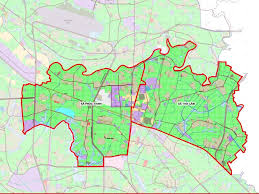
Hanoi has recently announced the selection of two adjacent communes, Phuc Thinh and Thu Lam, to pilot a socialist model in urban development. The decision, made by the Hanoi People's Committee, is based on the potential for growth, advantageous transportation links, and the capacity to organize new urban spaces in these areas.
The pilot project aims to transform these communes into models of socialist urban development by 2030, with a projected population increase to approximately 700,000 residents. The total area of the two communes is 86.53 square kilometers, currently housing nearly 199,000 people with an average income of about 90 million VND per year.
Phuc Thinh, covering 42.69 square kilometers and home to nearly 96,000 residents, has developed various residential areas, industrial clusters, and relocation zones. With an estimated budget revenue of nearly 1,880 billion VND by 2026, Phuc Thinh is positioned as a gateway to the north of the capital, benefiting from its proximity to major transportation routes and the Noi Bai International Airport.
On the other hand, Thu Lam spans 43.84 square kilometers and has around 102,800 residents. It has ample land available for development, with over 600 hectares yet to be allocated for projects. The area is strategically located along the Ca Lo River and near Bac Ninh province, making it attractive for investment and urban expansion.
The pilot project will assess the potential for large-scale spatial organization, inter-commune collaboration on infrastructure, public services, and regional economic development. After the model is refined, Hanoi plans to report to the Central Government for approval to merge the two communes into a new administrative unit.
In addition to the two pilot communes, 124 other communes in Hanoi will adopt similar criteria starting in 2026. The city aims to review the implementation of the project by 2030 to finalize the criteria and methods for broader application across the city.