Devastating Floods Hit Nepal-China Border, Claiming Lives
A catastrophic flood swept through the Nepal-China border, resulting in at least 95 fatalities and leaving
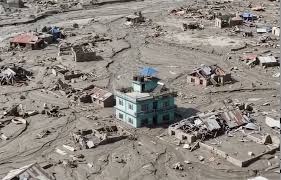
A house in Nepal has gained attention for its ability to remain standing amid devastating floods that occurred on August 26. While many surrounding structures were swept away or destroyed, this blue house was captured in a viral video, showcasing its resilience. Residents were seen safely sheltering on the balcony, prompting inquiries into how the house could withstand such powerful currents.
According to analyses by the social media account Architecture Presentation and NDTV, many homes in the Himalayan valleys of Nepal are primarily built from stone without reinforced concrete frames. These traditional structures can handle vertical loads but are vulnerable to horizontal forces from rushing water and debris. In contrast, the house featured in the video is believed to have been constructed with a reinforced concrete frame, where steel rods connect the columns, beams, and foundations into a unified structural system. This design allows the forces from water and mud to be distributed and transferred down to the foundation, rather than placing the entire burden on individual walls.
The house's location also plays a significant role in its survival. Positioned away from the main flow of the floodwaters, it avoids taking the full brunt of the water and debris. Additionally, the relatively compact shape of the house helps redirect water and mud away from its walls, preventing concentrated pressure on any single side. Accumulated mud around the structure may also create new terrain that directs subsequent water flows away from the house.
However, these observations are based on images and videos of the structure and do not constitute conclusions from a direct technical survey at the site. As of August 30, Nepal has reported 781 fatalities and 2,502 people missing, while China has reported 16 deaths and 546 missing in Tibet. Rescue teams continue to search for missing individuals under challenging weather conditions and rugged terrain. In Nepal, authorities have started to temporarily bury unidentified bodies due to decomposition after being trapped under mud for days. DNA samples and identification information are being preserved for future identification.
New data indicates that this was not an ordinary flood. Analysis from the U.S. Geological Survey (USGS) suggests that a portion of a glacier at an altitude of approximately 5,200 meters collapsed, causing ice and rocks to fall about 1,200 meters, resulting in a flow of mud, rocks, and water rushing downstream. The water level of the Trishuli River in some areas reportedly rose by up to 9 meters within 30 minutes. This material then traveled approximately 100 kilometers through the river system before causing widespread damage. According to the USGS, the glacier collapse generated seismic energy equivalent to a magnitude 5.2 earthquake.