Thai King and Queen Arrive in Vietnam for State Visit
On September 14, 2026, the King and Queen of Thailand arrived in Vietnam aboard a Boeing 737, marking their
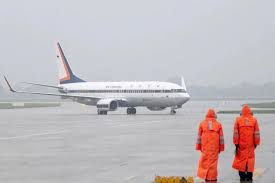
The royal plane of Thailand, bearing a special registration, successfully landed and took off from Noi Bai Airport during stormy weather, guided accurately by Hanoi air traffic controllers. On September 16, the plane carrying King Maha Vajiralongkorn and Queen Suthida departed from Noi Bai International Airport, concluding their three-day state visit to Vietnam.
Notably, King Vajiralongkorn himself served as the aircraft's captain, with the queen as co-pilot, and the king directly communicated with air traffic control. Behind the scenes, the teams from the Vietnam Air Traffic Management Corporation (VATM) were fully engaged, ensuring the safe navigation of the royal flight into Vietnamese airspace and its safe landing and takeoff at Noi Bai Airport.
VATM deployed its most experienced personnel for this operation. The team responsible for the royal plane's arrival on September 14 was led by Chief Controller Hán Thanh Sơn, who has 28 years of experience in air traffic control. Three days later, the team that oversaw the departure was led by Chief Controller Bùi Khắc Vinh, who has 21 years of experience. Hán Thanh Sơn noted that managing a flight carrying a head of state demands the highest safety standards, and it is exceedingly rare for a head of state to pilot the aircraft and communicate directly with air traffic control.
"When the voice of the King of Thailand came through the communication device, it was truly a special moment. However, the initial surprise quickly gave way to a professional mindset as the team focused intensely on the task at hand, ensuring all procedures were followed and standard aviation terminology was used," Sơn shared.
All exchanges between the control tower and the cockpit were conducted in standard aviation English, with controllers maintaining a calm demeanor while clearly reading instructions regarding altitude, flight direction, and speed. On the other end, the king responded accurately to each technical signal, transforming their dialogue into precise operational actions without error.
The pressure on the air traffic control teams not only stemmed from the royal flight's presence but also from the challenge of providing absolute priority to the royal plane while not disrupting the busy civilian air traffic at the capital’s main airport. A single miscalculation in maintaining safe distances between aircraft could lead to flight delays or safety risks.
The controllers had to calculate every available time gap in the sky, coordinating dozens of other commercial flights waiting or adjusting their approach paths to create a 'clean corridor' for the royal plane to land. The royal aircraft landed at Noi Bai amid heavy rain on September 14.
On September 16, the royal plane took off from Hanoi as northern Vietnam experienced widespread heavy rain, accompanied by strong thunderstorms and significantly reduced visibility. At the Long-Range Control Center (ACC Hanoi) and Noi Bai Control Tower, radar screens continuously displayed dangerous storm cloud bands, and meteorological information was updated every minute. The initial takeoff plan was at risk of being altered due to wind direction and cloud density.
Before departure, Chief Controller Bùi Khắc Vinh and his team continuously reviewed multiple contingency scenarios, from selecting taxiways to calculating runway friction on 11R, and preparing for changes in operational conditions. As planned, the royal plane powered up and taxied to runway 11R amidst heavy rain. The takeoff command was issued, and the aircraft ascended safely into the sky, maneuvering through adverse weather under the precise guidance of the approach radar system.
The flight concluded with a smooth handover between the Noi Bai approach control and long-range sectors before the royal aircraft exited the Hanoi flight information region. For air traffic controllers, the pressure during such moments is managed through thorough preparation, adherence to protocols, teamwork, and practical experience. Each member must be well-versed in both primary and contingency plans.
Chief Controller Bùi Khắc Vinh remarked, "Our impression was that the direct exchanges from the king on the frequency were conducted very professionally, in accordance with procedures and clearly articulated." For controllers, emotions may come after the mission; during operations, focus, accuracy, and discipline are paramount. The safety of a royal flight is the result of a well-oiled machine involving meteorological forecasters, technical staff, and air traffic controllers, who silently wear headsets in control rooms. The successful takeoff of the royal plane marked a successful visit to Vietnam, and for the aviation management teams in Vietnam, the reward after the intense hours on frequency is simply hearing a farewell from the cockpit, confirming a smooth and safe journey.