Massive Flash Floods Hit Nepal-China Border, Hundreds Missing
A catastrophic flash flood has struck the Nepal-China border, leaving hundreds missing and many feared dead.
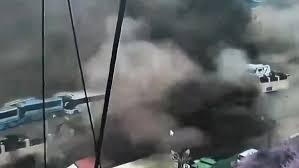
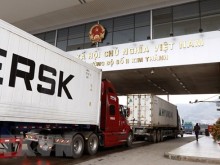
A catastrophic flood on August 26 has transformed the busy Gyirong border post between China and Nepal into a 'dead zone,' with hundreds of people missing. The flood, triggered by a massive ice collapse from the Langtang Lirung peak in the Himalayas, unleashed torrents of water that devastated the area, sweeping away everything in its path.
As the floodwaters surged, hundreds of individuals who were processing their travel documents at the Gyirong border post found themselves in a desperate situation. Many attempted to flee, but the speed and force of the rushing water left them with little chance of escape. Surveillance footage captured the moment the flood obliterated the border post, destroying vehicles and burying those trying to escape.
On September 6, Nhậm Vĩ, the Vice Chairman of the Tibet Autonomous Region, confirmed that 43 people had died and 519 were missing in the Chinese territory, including approximately 261 foreigners. In Nepal, the flood resulted in over 1,270 fatalities and more than 4,700 missing persons. Despite ongoing search efforts, rescue teams in China have yet to find any survivors in the Gyirong area, which has been largely flattened.
Chinese authorities have deployed dozens of excavators and bulldozers to work around the clock, constructing a temporary road along the riverbank to facilitate access to the border post. An international press team invited by China to survey the area on September 6 took about eight hours to travel from the capital, Lhasa, to the nearby city of Dingri, and then an additional six hours to reach the border post, navigating treacherous mountain roads.
The five-story customs building, characterized by traditional Chinese architecture, has been completely destroyed, leaving only remnants of its foundation. "When we started digging, all I could see were the remaining foundations. The entire structure above had been swept away by the flood. Witnessing this scene is truly heartbreaking. Many lives have been lost in this disaster," said Zhang Xiaoqiun, a rescue worker.
The Gyirong border post previously housed travel agencies, a supermarket, and a bridge connecting China with Nepal, all of which have been obliterated and buried under debris. The rescue teams face significant challenges due to the massive amounts of mud and debris, as well as the risk of secondary disasters such as landslides and further flooding.
Officials have warned of ongoing risks around the glacier area on the Langtang Lirung mountain in Nepal. The disaster may prompt China and Nepal to enhance monitoring of natural disaster risks, share data, and establish early warning systems, especially as climate change increases the unpredictability and frequency of such events. However, the immediate priority remains the search for victims.
Chinese authorities have not yet disclosed the identities or numbers of people present at the border post at the time of the disaster. Bo Weidong, Deputy Director of the Tibet Public Security Bureau, stated that over 60 experts are continuously working in three mobile laboratories to identify the bodies that have been recovered. The government is also cross-referencing immigration data and mobile location records to determine the missing individuals.
In the past 11 days, rescue efforts have frequently faced delays due to the threat of secondary disasters, such as landslides and the breaching of dammed lakes formed after the flood. Heavy rainfall and the mountainous terrain have also complicated access to the site by helicopter at times. "Our current approach is to dig down, search, and clear each layer before moving on to the next. We are excavating very carefully, examining each layer of debris in hopes of finding the victims' remains," said rescue team leader Yang Qiqiao.