U.S. Fighter Jets Launch from USS Abraham Lincoln
A recent video showcases U.S. fighter jets taking off from the USS Abraham Lincoln aircraft carrier,
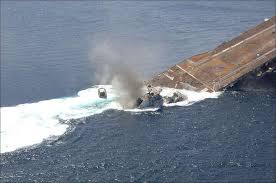
The USS Oriskany, a prominent aircraft carrier of the Essex class, was deliberately sunk by the U.S. Navy on May 17, 2006, after an extensive three-year preparation period costing approximately $20 million. This operation was not merely a demolition; it was a carefully planned effort to transform the ship into an artificial reef, providing a habitat for marine life in the Gulf of Mexico.
Measuring about 277 meters in length and displacing around 27,000 tons, the USS Oriskany was capable of operating up to 80 aircraft. However, its sinking was not the result of a naval battle or weapons testing but rather a strategic decision by the Navy to repurpose the vessel. The preparation involved the removal of hazardous materials, including fuel, oil, batteries, asbestos, and other toxic substances, to ensure environmental safety.
Over 150 workers were involved in the meticulous task of cleaning and dismantling the ship. One of the significant challenges was dealing with polychlorinated biphenyls (PCBs), chemicals that had been widely used in older ships. The Navy had to eliminate most of these materials before the Oriskany could be safely sunk.
The USS Oriskany was commissioned in 1950 and played a crucial role during the Korean War, participating in various airstrike missions and earning two battle stars. It survived a catastrophic fire in 1966, which claimed the lives of 44 crew members, and continued to serve until its decommissioning in 1976. After being removed from the naval registry in 1989, various plans to preserve it as a museum failed, leading to the decision to sink it as an artificial reef.
To sink the Oriskany, the Navy did not utilize a massive explosion. Instead, small charges of C-4 explosives were strategically placed in eight engine rooms. This method allowed water to flood the ship in a controlled manner, ensuring that it sank slowly and evenly. The entire process took about 37 minutes, resulting in the ship resting upright on the ocean floor rather than capsizing.
Today, the Oriskany lies at a depth of approximately 64-65 meters in the Gulf of Mexico, about 22.5 nautical miles southeast of Pensacola. The wreck has become a popular diving destination, with recreational divers able to explore the upper sections of the ship while deeper areas require advanced diving skills and equipment.
Over time, the steel structure of the Oriskany has fostered a new ecosystem, attracting various marine species such as grouper and snapper. What was once a vessel designed for warfare has now become a sanctuary for marine life, showcasing the transformative power of repurposing historical artifacts.