Spire Global Secures $3.7 Million NOAA Contract for Weather Data
Spire Global has been awarded a $3.7 million contract by the National Oceanic and Atmospheric Administration
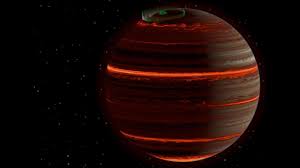
The James Webb Space Telescope (JWST) is paving the way for interstellar weather forecasting, as researchers analyze its observations to understand the atmospheres of distant worlds. A recent study focused on SIMP 0136, a brown dwarf approximately 20 light-years from Earth, revealing significant insights into its atmospheric patterns.
Brown dwarfs, which are more massive than planets but do not sustain hydrogen fusion like stars, provide a unique opportunity for astronomers to study atmospheric dynamics. The research team utilized a technique known as principal component analysis to examine subtle brightness changes of SIMP 0136 as it rotates. This analysis distilled a complex dataset into several key patterns that account for most of the observed atmospheric variability.
The findings indicated that the weather on SIMP 0136 is influenced by two main factors: temperature differences and variations in the vertical structure of its clouds. The researchers identified three recurring weather states that rotate into view, characterized by regions of varying temperatures and cloud thicknesses. Hotter areas exhibited thinner clouds, while cooler regions were associated with thicker clouds extending higher into the atmosphere.
Study lead author Merle Schrader, a doctoral candidate at Trinity College Dublin, emphasized the importance of understanding whether these atmospheric drivers remain consistent over time. The research revealed that the factors influencing SIMP 0136's weather patterns do persist, even as the atmospheric appearance evolves over numerous rotations.
While this method does not yet allow astronomers to predict immediate weather conditions on distant worlds, it offers a quicker approach to identifying the forces shaping these atmospheres. Co-author Johanna Vos, an associate professor at Trinity College Dublin, noted that applying this technique to a broader range of brown dwarfs and giant exoplanets will enhance our understanding of the diverse weather systems beyond our solar system.
This groundbreaking research was published in the journal Astronomy & Astrophysics on September 16, 2026, marking a significant step forward in the field of astrophysics and the study of alien weather systems.