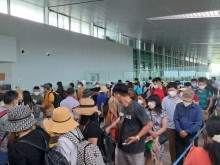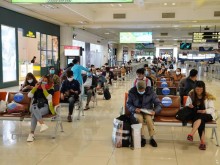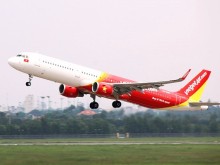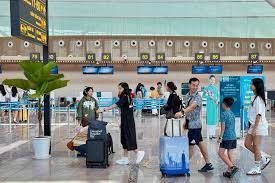
Airfare prices for numerous routes in Vietnam have surprisingly dropped, despite the ongoing high costs of fuel and other operational expenses. According to a report from September 12, travelers can find round-trip tickets for journeys such as Ho Chi Minh City to Da Nang for as low as 1.2 million VND, which is about half the price compared to August.
Similar trends are observed across other popular travel routes, including Ho Chi Minh City to Phu Quoc, Da Lat, and Nha Trang, where prices range from 1.2 to 1.8 million VND per passenger, depending on the airline and time of travel. The Ho Chi Minh City to Hanoi route currently offers fares between 800,000 and 900,000 VND one way, while the Ho Chi Minh City to Vinh route is priced around 900,000 to 1 million VND.
Despite these low prices, many potential travelers remain hesitant to book flights at this time. One traveler, Hanh Thao, mentioned that although she received a hotel voucher for Phu Quoc and found round-trip tickets for about 1.3 million VND, the rainy season and the start of the school year have made family travel less of a priority.
The drop in airfare does not necessarily indicate a decrease in travel demand. A representative from Vietnam Airlines explained that the lower prices in September and October reflect a flexible pricing mechanism based on seasonal demand and booking patterns rather than a unilateral price cut. The airline industry is notably seasonal, with peak periods during the Lunar New Year and summer months. The months following the summer often see a significant drop in family travel as students return to school, shifting the market focus towards business travelers and those visiting family.
However, this low season does not equate to uniformly low demand across all routes. Certain days, times, or destinations may still experience higher passenger volumes, particularly during weekends, short holidays, or local events. Airlines must closely monitor booking patterns to adjust pricing, flight frequency, aircraft types, and operational plans accordingly.
Airlines typically do not set a fixed fare for flights; instead, they offer a range of prices. The appearance of attractive prices during low seasons does not mean that all flights are sold at the same rate. Competition among airlines also influences pricing during these periods, but it is not the sole factor. Airfare is affected by seasonal supply and demand, load factors, booking timing, customer demographics, purchasing power, operating costs, and revenue management strategies.
Experts suggest that the current low season is no longer a complete lull for the travel industry. Instead of focusing solely on major holidays, there is a growing demand throughout the year driven by weekends, short vacations, local cultural events, and regional tourism seasons. The travel behavior of Vietnamese customers has evolved, leading to more fragmented demand across different regions and routes.
Fuel costs, which account for about 30-40% of an airline's operating expenses, significantly impact profitability. For Vietnam Airlines, every increase of 1 USD per barrel of fuel can add over 300 billion VND to annual costs. Despite reporting a consolidated profit of over 4.5 trillion VND in the first quarter, rising fuel prices in the second quarter increased costs by more than 7 trillion VND. With an average fuel price forecast of 120 USD per barrel for the second half of the year, the airline aims for profitability, albeit at a more modest level than in 2025.
Vietjet faces similar challenges, despite its different business model. The airline reported a revenue increase of over 70% year-on-year in the second quarter, but its net profit dropped by 46.5% due to high fuel prices eroding profit margins. Current data indicates that the cost of Jet A1 fuel is around 170 USD per barrel, a 90% increase compared to the previous year.
Despite the significant impact of fuel costs, airlines continue to offer low fares. Representatives from Vietnam Airlines noted that while fuel remains one of the largest expenses, profitability is not calculated on a per-seat basis but rather on total flight revenue and overall network efficiency. Selling additional seats at lower prices, even below the average, can still enhance total revenue compared to leaving them empty.