Ukraine Prepares for New Mobilization Amid Ongoing Russian Offensive
As Ukraine gears up for a new wave of mobilization in August, Russia continues its steady offensive in the
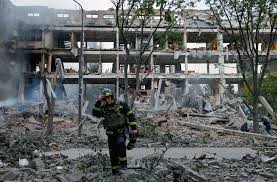
As Russian forces increase their pressure on Ukraine's final defensive urban cluster in Donetsk, Kyiv is implementing its most significant command restructuring since 2022. This move involves promoting battlefield generals to key positions, reflecting an effort to change the approach to warfare amidst ongoing conflict.
On August 26, Ukrainian President Volodymyr Zelensky visited the Eastern front and announced a notable decision: two reorganized military groups in Donetsk will be led by General Andrii Biletskyi, Commander of the 3rd Corps, and General Denys Prokopenko, Commander of the 1st Azov Corps of the National Guard. These commanders are among Ukraine's most prominent battlefield leaders, representing a generation of officers shaped by over a decade of conflict since 2014.
This decision underscores the significance of Donetsk in Ukraine's military strategy. Russian forces are exerting pressure from both the south and east on the urban cluster of Kostiantynivka - Druzhkivka - Kramatorsk - Sloviansk, often referred to by Western military analysts as the "fortress belt." Unlike a single fortification, this is a system of urban areas, roads, industrial zones, and interconnected defensive lines that Ukraine has fortified over the years.
After Russia captured Pokrovsk in late 2025, Moscow's operational focus shifted northward towards the urban chain from Kostiantynivka to Sloviansk. The loss of Pokrovsk has expanded Russia's operational space towards Dnipropetrovsk, allowing them to concentrate on Ukraine's remaining strongholds in Donetsk.
The southern gateway of this defense line is Kostiantynivka. Since late June, Russian forces have utilized small infantry units to infiltrate the city instead of large mechanized assaults that caused heavy losses in the early years of the war. This manpower advantage enables Russia to maintain pressure, despite significant challenges posed by Ukraine's medium-range strikes on Russian logistics.
As of August 26, the U.S.-based Institute for the Study of War (ISW) assessed that while Russian forces have penetrated various areas, Ukrainian troops still maintain positions in the north and northwest of Kostiantynivka. Thus, declaring the city completely fallen is premature.
From Russia's perspective, Kostiantynivka is a crucial logistical hub on the Druzhkivka - Kramatorsk - Sloviansk axis. Russian media views the ability to advance from Chasiv Yar as essential for increasing pressure on the entire urban cluster to the north of Donetsk.
Moreover, Russia is preparing for the next offensive. According to ISW, Moscow is conducting operations to disrupt supply lines, bridges, railways, and transportation routes before infantry advances. UAVs, missiles, rocket artillery, and especially glide bombs are increasingly being used around Kramatorsk and Sloviansk, aiming not only to destroy fortifications but also to turn urban environments into rubble, providing cover for small infantry units to infiltrate deeply.
The pressure is becoming more tangible each day. The Polish Center for Eastern Studies (OSW) reported that Sloviansk was included in the list of conflict zones by the Donetsk authorities on August 21, following intense bombing and advances by Russian troops in the east. On August 25, Deutsche Welle reported at least 24 injuries from guided bombings targeting Kramatorsk. By August 26, ISW noted that Russia was using both glide bombs and long-range rocket artillery against Sloviansk.
However, "critical" does not equate to "collapse." ISW suggests that even if Russia completely controls Kostiantynivka, it does not automatically create a rapid operational breakthrough into Kramatorsk and Sloviansk. Russia still faces the challenge of crossing additional territories, rivers, supply routes, and deeply defended urban areas.
In this context, on July 21, President Zelensky decided to replace Commander Oleksandr Syrskyi, 60, with Major General Mykhailo Drapatyi, 43. The Ukrainian Ministry of Defense confirmed that Drapatyi officially assumed command on July 22. This leadership change is regarded as the most significant military restructuring in Ukraine since Russia launched its full-scale military campaign in February 2022.
The generational shift in Ukraine's military leadership is evident. Alongside General Drapatyi, Major General Ihor Skybiuk has been appointed as Chief of Staff, while battlefield officers like Biletskyi and Prokopenko are given greater responsibilities in critical areas. The Financial Times notes that the replacement of both the Commander and Chief of Staff reflects a desire to bring a younger generation of leaders, who have been shaped directly by modern warfare, into the military command structure.
General Drapatyi embodies this transformation; he has fought since 2014, previously commanding units out of encirclement and stabilizing the Kharkov front after Russia's offensive in 2024. As the youngest army commander in Ukraine's history, Drapatyi aims to reform recruitment, training, and encourage initiative among frontline commanders, marking a departure from the centralized command model rooted in Soviet military tradition.
However, the greatest limitation of this "blood change" lies in a simple reality: no commander can lead forces that do not exist. Reports indicate that many frontline infantry positions in Ukraine remain thin, while the mobilization process continues to spark social debate. Despite suffering heavy losses, Russia still maintains a numerical advantage in several directions.
On August 23, President Zelensky stated that Russia could replenish approximately 300,000 troops following the upcoming State Duma elections in September. This assessment, while unverified by independent sources, reflects Kyiv's genuine concern regarding the long-term war of attrition.
Ukraine is also under significant financial pressure. President Zelensky mentioned a projected defense budget gap of around $27 billion for 2026. Former Defense Minister Mykhailo Fedorov refuted this calculation, arguing that the plan he developed left a much smaller deficit. Regardless of which figure is closer to reality, the debate highlights that high-tech warfare is consuming resources at a pace that even a Western-supported nation like Ukraine struggles to keep up with.
Fedorov, who has publicly welcomed General Drapatyi's appointment despite previous conflicts with General Syrskyi, argues that Ukraine needs a battlefield system that integrates sensors, ground and aerial UAVs, artificial intelligence (AI), and affordable missile interceptors to reduce the number of soldiers required on the front lines. He warns that Kyiv has only "a few months" to make pivotal decisions.
These insights must be viewed in the context of Fedorov's political disagreements with President Zelensky's administration, but they reflect a broader issue: Ukraine finds it challenging to win a purely attritional war based on manpower and artillery. Consequently, Kyiv is striving to shift the war equation from quantity to efficiency.
General Drapatyi is tasked with enhancing counteroffensive operations, expanding campaigns behind Russian lines, developing technology, and improving combat capabilities. On August 26, President Zelensky reiterated the need to increase production of ground robotic systems and to better organize medium-range strikes. This indicates that personnel restructuring, technological reform, and doctrinal changes are being pursued as a unified package.
Russia is also adapting in a similar direction. On August 5, President Vladimir Putin appointed Denis Lyamin to command a newly established unmanned systems force while adjusting leadership within the "Center" group, one of the main military formations involved in the Donetsk campaign. According to Reuters, Putin stated this is a process of continuously refining the military structure in line with battlefield experience. Thus, the race in Donetsk is not only between two armies but also between two military learning processes.