VND2.2 trillion project proposed to improve railway connections with China
NDO/VNA – The Vietnam Railway Project Management Board under the Ministry of Transport has submitted to the
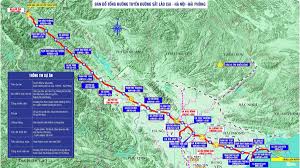
The Lao Cai - Hanoi - Hai Phong railway project is undergoing a significant budget increase, with the total investment expected to rise by more than 86 trillion VND. The Vietnamese government has proposed to the National Assembly to adjust the total investment from 203.2 trillion VND to 289.3 trillion VND, reflecting an increase of 86.1 trillion VND compared to the preliminary total approved by the National Assembly in 2025.
According to the Railway Project Management Board under the Ministry of Construction, one of the primary reasons for this budget increase is the addition of the Yên Viên - Gia Lâm section, which is 8.4 kilometers long. This adjustment also involves relocating the northern passenger terminal from Yên Viên to Gia Lâm. As per the master planning for Hanoi, Gia Lâm is designated as the northern passenger terminal, while Yên Thường will serve as the freight terminal.
The construction of the Yên Viên - Gia Lâm railway section aims to connect with the national railway and urban railway lines in Hanoi, facilitating the development of the Gia Lâm station area based on the Transit-Oriented Development (TOD) model. This addition alone is expected to increase the project budget by approximately 21.6 trillion VND, which includes 7.8 trillion VND for construction and 13.8 trillion VND for land clearance.
Furthermore, the section between Hanoi and Hai Phong has been shifted from a phased investment plan to a dual-track investment from the outset, resulting in an additional 22.8 trillion VND in funding. Railway project representatives noted that demand forecasts indicate that within ten years of operation, the capacity may necessitate a second track. The previous plan involved constructing a single track first, with a second track to be added by 2045. However, this approach would incur higher costs and risks due to the need for construction while the first track is operational.
Investing in a dual track from the beginning is projected to reduce land usage needs by about 115 hectares, saving approximately 4.8 trillion VND in land clearance costs and 12.6 trillion VND compared to the total costs of completing the dual track under the phased approach. Additionally, this method eliminates the need for two technical stations and allows for the replacement of two single bridges with one double bridge. This coordinated investment is expected to increase train speeds from around 95 km/h to 120 km/h, reducing travel time by approximately 14 minutes and providing an estimated annual economic benefit of 50 billion VND.
Geotechnical surveys have indicated that the area has weak soil foundations. If the second track were to be constructed after the first track is operational, the risk of subsidence affecting the operational line would be significantly higher. Moreover, some constructions may overlap with the expressway connecting Hanoi to Gia Bình airport and the newly approved Hanoi - Quang Ninh railway line.
Despite a reduction in the total land area required for the project—from 2,632 hectares to 2,075 hectares—the costs for land clearance have risen by approximately 34.8 trillion VND. Local authorities have accurately defined the land acquisition boundaries, detailed the inventory, and updated compensation policies according to the latest land pricing regulations for 2026.
The project has also seen a budget increase of 15.3 trillion VND due to the addition of vehicles and equipment, as well as adjustments in pricing and exchange rates for imported equipment. Among this, the exchange rate differences account for about 1.8 trillion VND, while investment rate differences add 2.3 trillion VND. Adjustments to certain design solutions have also contributed an additional 5.4 trillion VND to the budget.
Overall, while the total investment has increased significantly, the portion attributed to subjective reasons remains lower than the contingency amount of approximately 30.8 trillion VND that was included in the approved investment plan. The Lao Cai - Hanoi - Hai Phong railway project, approved by the National Assembly in 2025, spans approximately 417 kilometers, with the main line measuring 389 kilometers and the branch line 27.9 kilometers. Under the new plan, the main line's length will decrease to 362 kilometers, while the branch line will increase to 62 kilometers. The project will commence construction in 2025, with a target completion date set for 2030.