First Vietnamese woman reaches summit of Mount Everest
Nguyễn Thị Thanh Nhã, also known as Celine Nha Nguyen, has become the first Vietnamese woman to conquer the
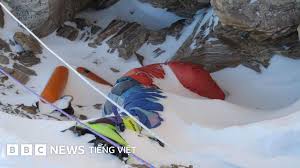
The body of an Indian climber, famously known as 'Green Boots,' has been lying on Mount Everest for three decades. This climber, Dorje Morup, perished in 1996 while attempting to summit the mountain. His remains, still clad in green climbing boots, have become a grim landmark for other climbers on their ascent. Now, Indian authorities are planning a professional recovery operation to bring his remains back home, a move that is hoped to provide closure for his family.
Morup, a seasoned mountaineer, was part of an Indian expedition aiming to conquer Everest from the northern route in Tibet. On May 10, 1996, he and his team faced a fierce snowstorm during their descent, which tragically led to the deaths of three climbers, including Morup. While the bodies of his two companions were never recovered, Morup's body has remained visible, frozen in the snow.
For years, 'Green Boots' was believed to be another climber, Tsewang Paljor, but recent investigations have led officials to reassess this identification. Evidence, including clothing and equipment found with the body, suggests that it is indeed Morup's remains. An official from the Indo-Tibetan Border Police (ITBP) stated, "We have never forgotten him; it was just a matter of time before we could bring him back." The recovery operation is expected to be challenging due to the harsh conditions at high altitudes.
Morup's wife, Konchak Yangskit, recalls the night before his expedition, filled with both pride and apprehension. She has lived with the uncertainty of his fate for decades, stating, "It is hard to believe he is dead because I have never seen his body." Now, as the ITBP prepares to undertake the recovery, she and their family hope to finally bring him home.
The operation to retrieve Morup's body is complicated by the altitude of approximately 8,500 meters where he lies, within the so-called 'death zone' of Everest. Experts estimate that the cost of such a recovery could range from $40,000 to $80,000, depending on the logistics involved. The ITBP aims to complete the recovery by September 2026, but conditions on the mountain can be unpredictable.
In the years since Morup's passing, his family has held memorials and prayers in his honor. His son, Punchok Dorjai, expressed the family's desire to honor his father's legacy as a hero. "My father sacrificed his life for the country, and he deserves to be remembered as a martyr," he said. The family plans to keep Morup's green boots as a symbol of his legacy, alongside the certificate from the Chinese government confirming his successful summit of Everest.
As the recovery effort approaches, Yangskit reflects on the long years of waiting and the hope that her husband will finally return home. "When he comes back, I will ask him, 'Where have you been all these years?'" she said, filled with both anticipation and sorrow.