Ukraine's Liman Falls as Russian Forces Advance in Donetsk
Reports indicate that the city of Liman has fallen to Russian forces, with Ukraine rapidly retreating
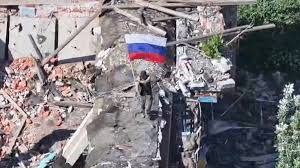
Russia has announced that it has achieved full control over the strategic city of Konstantinovka, a critical gateway in the Donetsk region. This development is seen as a significant advancement in Russia's ongoing military operations aimed at pushing back Ukrainian forces entrenched in the Donetsk fortress area. Dmitry Peskov, spokesperson for the Kremlin, stated on July 3, "The important news is that Konstantinovka has fallen. The city is now entirely under our control." Following this announcement, the Russian Ministry of Defense released videos showing soldiers raising flags in various locations throughout the city.
On the same day, President Vladimir Putin visited a logistics base associated with the Joint Forces, the command agency overseeing the special military operation in Ukraine. He expressed gratitude to Russian soldiers and emphasized the strategic importance of controlling Konstantinovka, stating, "This is a very important first step in the effort to defeat the Ukrainian military units that are holding the urban axis of Slavyansk - Kramatorsk - Konstantinovka." He noted that the Ukrainian forces had established an extensive network of strongholds, turning the cities of Slavyansk, Kramatorsk, Druzhkovka, and Konstantinovka into a fortified belt.
General Anton Grunis, commander of the 4th Motorized Rifle Brigade of the Russian Southern Group, reported that Russian troops had advanced from multiple directions, isolating Ukrainian defensive forces into smaller pockets and neutralizing individual targets. "We are conducting operations to flush out enemy soldiers hiding in buildings, cellars, and rubble in Konstantinovka," he said. Ukrainian officials have yet to comment on this development.
According to the BBC, Ukrainian soldiers had previously described Konstantinovka as a "gray zone," a term used to refer to areas where fighting is ongoing and no side has complete control. Some Ukrainian commanders acknowledged that Russian forces had penetrated so deeply that they could not be pushed back, and the defensive units faced the risk of losing the city. A Ukrainian drone pilot in the city remarked that the situation had escalated into a "serious crisis."
Konstantinovka, covering an area of over 66 square kilometers, was once an important center for iron, steel, zinc, and glass production during the Soviet era. Before the conflict erupted, the city had a population of about 70,000 people. It initially served as a logistical hub for Ukrainian forces in Bakhmut and Chasov Yar, cities that Russia fully controlled by May and August 2025, respectively. Konstantinovka also serves as the gateway to a series of urban areas forming Ukraine's "fortress belt" in the Donetsk province.
This fortress belt, approximately 50 kilometers long, includes the cities of Konstantinovka, Druzhkovka, Slovyansk, and Kramatorsk. It represents Ukraine's most fortified defensive line in the Donetsk province, featuring a complex of trenches, anti-tank obstacles, and dense barbed wire that has been reinforced over the past decade, posing significant challenges to Russian offensive operations. The fall of Konstantinovka could expose nearly all remaining urban areas to drone and artillery strikes, bringing Russia closer to its goal of full control over the Donetsk province.