National Route 13 Expansion to Alleviate Traffic Congestion
The expansion of National Route 13, a key project in Ho Chi Minh City, is set to begin around the National
On August 29, Ho Chi Minh City celebrated the groundbreaking and inauguration of 11 major projects, collectively valued at over 181 trillion VND (approximately $7.5 billion). This initiative marks a significant step towards improving the city’s infrastructure and urban landscape, coinciding with the upcoming National Day celebrations on September 2.
The total investment announced by the city amounts to 181,412 billion VND, sourced from the state budget, public-private partnerships (PPP), World Bank loans, and private enterprises. Among the eight projects that commenced, the transportation sector received the largest allocation of funds, which includes upgrades to National Highways 1 and 13, as well as two components of the Ho Chi Minh City Ring Road 4.
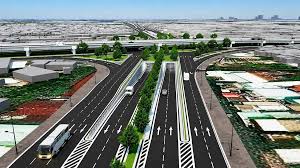
Specifically, the section of National Highway 13 from Binh Trieu Bridge to the old border of Binh Duong province, spanning approximately 5.9 kilometers, will be expanded to 60 meters with a capacity of 10-14 lanes. The total investment for this project is around 20,678 billion VND, which includes compensation, support, resettlement, and upgrades under the PPP model, with a BOT contract. The PPP project alone has an investment of about 6,276 billion VND, led by the CII Public-Private Partnership Company.
The design for the underpass in the upgrade project features a two-way, two-lane configuration, integrated with ground-level and elevated sections to form a three-tier interchange, alleviating traffic congestion at the northeastern gateway. This project is expected to enhance connectivity between the city center and industrial zones, airports, and seaports, with a completion date projected for late 2028.
In the western gateway, National Highway 1, from Kinh Duong Vuong to the old border of Long An province, will also undergo upgrades and expansions. This section, approximately 9.62 kilometers long, will have a cross-section of 60 meters and a capacity of 10-12 lanes. The project consists of three components, with a total investment of around 16,285 billion VND, of which approximately 6,674 billion VND will be allocated for the upgrade under the PPP model. This project is expected to be completed by 2029, significantly increasing the traffic capacity across the east-west corridor and connecting Ho Chi Minh City with the Mekong Delta provinces.
Additionally, the city kicked off two components of Ring Road 4, including the section from Toc Tien Intersection to Chau Pha Bridge and the Saigon River to Thay Cai Canal section. The Toc Tien to Chau Pha section is about 18.25 kilometers long, with an investment of 5,247 billion VND, while the Saigon River to Thay Cai section is approximately 16.7 kilometers long, with a budget of 8,761 billion VND. The central budget contributes over 3,035 billion VND, with the remainder raised by investors. Both projects are expected to be completed by 2029.
The total investment for the entire Ring Road 4 project is approximately 120,413 billion VND, encompassing ten components utilizing both public and PPP funding, representing the largest portion of the total investment of 181,412 billion VND for the projects announced.
In the city center, Ho Chi Minh City has also launched the renovation project for the Ma Lang area and the Chicken-Rice Market, with a total investment of around 15,674 billion VND. This project will be executed under the PPP model, with Khang Dien Investment and Real Estate Company as the investor. The Ma Lang area, located in the Cau Ong Lanh ward, covers nearly 3.8 hectares and will see comprehensive investment in technical and social infrastructure, including a combined school for grades 1-2 and approximately 1,400 social housing units.
The Chicken-Rice Market area, located in Ben Thanh ward, spans about 4,350 square meters and will be developed with infrastructure and around 760 social housing units for resettlement purposes. Both areas, situated in the city center, have been under long-term planning for nearly three decades. The project does not include commercial housing development, focusing instead on providing resettlement housing for affected residents. The completion date is also set for 2029, aiming to improve living conditions and enhance the urban landscape while resolving long-standing planning issues.
In the environmental sector, a project to improve water quality in Binh Duong province has been initiated, with a total investment of approximately 7,211 billion VND, funded by the budget and World Bank loans. This project will establish a wastewater collection and treatment system in Tan Uyen, Thuan An, and Di An, including a network of pipelines and pumping stations, along with the construction and upgrading of treatment plants. The additional processing capacity will be around 60,000 cubic meters per day, expected to be completed by 2028, significantly reducing urban wastewater pollution and protecting water sources.
Furthermore, the city has launched two social housing projects, including one in the Tien Phuoc residential area within the new urban area, covering over 3,100 square meters and featuring 18 floors with approximately 342 apartments, at an investment of 306 billion VND. The second project, Lê Thành Tân Tạo 2 in Binh Tan ward, will consist of 450 apartments with a total investment of around 550 billion VND, utilizing land and funding from the enterprise.
Additionally, three educational facilities with a total investment of 295 billion VND have been inaugurated, including upgrades to the Marie Curie High School building, the construction of 45 classrooms and functional rooms at Vo Truong Toan High School, and the enhancement of teaching equipment at Tran Van Giau High School.
At the groundbreaking ceremony for National Highway 13, Nguyen Cong Vinh, Deputy Chairman of Ho Chi Minh City, emphasized that these projects will strengthen multiple pillars of the city’s development, from regional transportation connectivity to urban redevelopment, social housing, environmental improvement, and education. He noted that National Highways 1, 13, and Ring Road 4 will alleviate traffic bottlenecks and expand the development space for the southern economic region. Meanwhile, the renovation of Ma Lang and the Chicken-Rice Market, along with the construction of social housing, aims to replace degraded residential areas with safer and more integrated living spaces. City leaders have urged investors and contractors to ensure progress, quality, and safety while effectively implementing resettlement plans, with the goal of providing new homes for residents that are equal to or better than their previous living conditions.