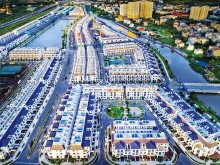
Home prices edge up in Q3
HCMC – The third quarter of this year saw prices of detached homes and condos growing across the country’s
The Vietnamese real estate market is witnessing a substantial cooling off, with prices for various types of properties decreasing significantly. According to a report from PropertyGuru Vietnam, residential properties have experienced price drops ranging from 9 to 12 million VND per square meter, while land lots and villas have seen reductions of 1 to 5 million VND per square meter.
In the second quarter of 2026, prices for street-front houses decreased by 3%, dropping from 214 million VND per square meter to 202 million VND per square meter. Private houses saw a 6% decline, falling from 139 million VND per square meter to 130 million VND per square meter. Similarly, villa prices also dropped by 6%, from 153 million VND per square meter to 148 million VND per square meter. Land lot prices decreased by 2%, from 41 million VND per square meter to 40 million VND per square meter. In contrast, apartment prices remained stable at 70 million VND per square meter.
In Ho Chi Minh City, the trend mirrors that of the national market, with street-front houses, land lots, and villas seeing price reductions compared to the first quarter of 2026. Notably, villa prices fell from 160 million VND per square meter to 150 million VND, and land lot prices dropped from 68 million VND per square meter to 66 million VND. Street-front house prices decreased slightly from 198 million VND per square meter to 197 million VND. However, private house prices increased slightly from 116 million VND per square meter to 117 million VND, and apartment prices rose from 69 million VND per square meter to 70 million VND.
According to PropertyGuru Vietnam, the apartment segment continues to show the most potential for growth in the latter half of the year, with 64% of apartment buyers purchasing for residential purposes and 36% for investment. Dinh Minh Tuan, the regional director for southern Vietnam at PropertyGuru, noted that the Vietnamese real estate market is entering a new development cycle driven by planning, infrastructure, transparency, and actual demand.
He highlighted three significant changes occurring simultaneously in the market. Firstly, planning and infrastructure are becoming crucial drivers, redistributing supply and demand. In Hanoi and Ho Chi Minh City, long-term planning directions and key infrastructure projects such as metro lines and highways are gradually reshaping the real estate development landscape. New supply is shifting away from central areas to near-central regions, satellite areas, and new development axes.
Secondly, the market is moving towards greater transparency. Policies related to standardizing transactions, building market data, land databases, and broker certification are laying the groundwork for a more professional market. While these changes may not have an immediate impact on liquidity in the short term, they will contribute to reducing information asymmetry, limiting rumors, and enhancing transaction quality in the long run.
Lastly, the market is experiencing significant differentiation. Unlike the 2021-2022 period when many segments saw price increases, by 2026, the dynamics among property types have become distinctly different. Apartments continue to attract interest due to real housing demand and stable rental potential, while land lots and some speculative asset types show signs of stagnation or adjustment in certain areas.