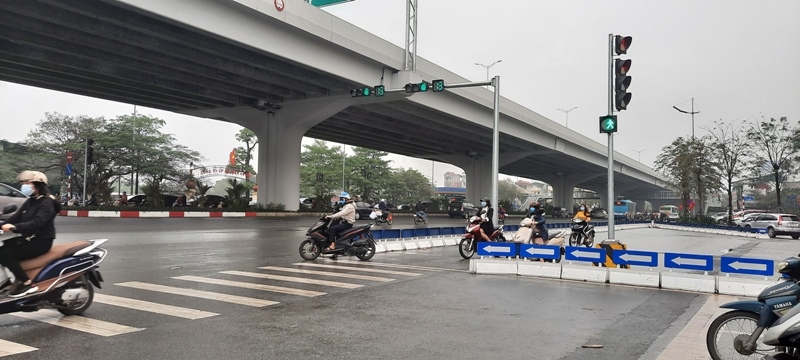
Cabinet meeting looks into major transport projects
NDO/VNA – Infrastructure development, including transport infrastructure, is a strategic breakthrough of the
NDO - As the economy bouncing back from woes brought about by the health crisis, the government will continue accelerating the disbursement of public investment this year, with a focus placed on infrastructure development which is one of the key driving forces for higher economic growth.
On March 1, 2022, Prime Minister Pham Minh Chinh hosted an online meeting between the government and some localities on the pre-feasibility study reports on five national key transport projects.
These projects include the belt road No.4 of the Hanoi capital area; the belt road No.3 of Ho Chi Minh City; the Chau Doc – Can Tho – Soc Trang expressway; the Khanh Hoa – Buon Ma Thuot expressway; and the Bien Hoa – Vung Tau expressway. These projects are more than 500 kilometres in length.
“Infrastructure development, including transport development, is one of the three breakthroughs determined by the Party and the state for boosting economic growth. The resolution of the 13th National Party Congress has set a target of completing the construction of 2,000km of expressway within this term of office [2021-2025],” PM Chinh stated.
Currently the country has been constructing more than 700km of expressways.
“These five new projects are very important to economic growth of many localities in particular and of the whole economy in general. To succeed in materialising the projects, greater efforts are needed with many more types of resources including investment capital and human resources, as well as how to implement the projects,” PM Chinh continued.
The investment capital is set to come from the central budget and localities’ coffers which are used as part of the country’s medium-term investment plan and programme on socioeconomic recovery and development recently adopted, and also come from other capital sources.
Hanoi’s government has also adopted a plan to use its own budget to invest as much as 76.3 million USD into five infrastructure projects crucial to local residents of its outskirts. For instance, one of the projects valued at 20 million USD is to build a 1.1km road in Xuan Dinh area western of the West Lake which is considered a gigantic lung of the city.
It is calculated that by 2025, Hanoi will need around 21 billion USD worth of public investment for developing its own infrastructure projects. Last year the city approved a resolution for implementing its 2021-2025 public investment plan.
In another case, Ho Chi Minh City People’s Council in late 2020 adopted a scheme on investing 1.95 billion USD in infrastructure development for this year, including 108.56 million USD sourced from the central coffers. The upcoming projects will be focused on upgrading and newly building roads, channels, railways, and hospitals.
Increasing investment
In the Socio-economic Development Plan for 2022 it passed last November, the National Assembly stated that so as to ensure an economic growth rate of 6-6.5% for this year, which will lay solid groundwork for reaching an economic growth target of 6.5-7% for the 2021-2025 period, a disbursement rate of more than 90% in public investment for 2022 must be achieved.
Nevertheless, the government’s dated January 8, 2022 on key tasks and solutions for the implementation of the country’s socio-economic development plan and state budget estimates for 2022 ordered that the rate of public investment disbursement for this year must be 100%.
“Public investment must act as a primer to attract all legitimate resources for national development and economic growth, particularly through public-private partnerships (PPP),” the resolution stated.
The resolution noted that in this year, the government will speed up the building of key infrastructure projects that connect regions nationwide for socio-economic development, attraction of poverty, employment generation, and poverty reduction. The projects will particularly involve crucial transport ones including a number of intersections of the Eastern Cluster of North-South Expressway with total state funding to sit at 6.39 billion USD, the Long Thanh International Airport, the My Thuan-Can Tho expressway, and the metro lines in Hanoi and Ho Chi Minh City currently under construction.
Since late last year, the government has always highlighted the acceleration of disbursement of public investment in its meetings on socio-economic development, considering it as one of the most important duties in 2022 of the government, ministries, localities, and state-owned enterprises.
“All impediments have to be phased out immediately. Accelerated disbursement have to be commensurate with ensuring the quality of projects. Leaders of ministries, localities, and all units have to must be held accountable for their units’ disbursement results,” PM Chinh said.
The legislative body last month adopted a monetary and fiscal policy package aimed to support the programme on socioeconomic recovery and development. Under this package, an estimated sum of 4.95 billion USD for infrastructure development will be implemented. This sum included 4.48 billion USD aimed for road construction; 256.5 million USD to be earmarked for digital transformation infrastructure; and as much as 217.4 million USD for developing projects aimed to cope with climate change and weathering aftermath caused by natural disasters.
Last November, the government passed total public investment for 2022 of 26.58 billion USD. This included 13.24 billion USD from the central coffers – embracing domestic capital of 11.25 billion USD and foreign capital of nearly 2 billion USD.
The Ministry of Planning and Investment (MPI) reported that as of December 31, 2021, the country’s public investment rate reached 77.3% of the plan earlier assigned by the prime minister, lower than 82.66% recorded in 2020. In which, the disbursement of domestic capital sat at 83.66%, lower than 87.12% in 2020, and that of foreign capital reached 26.77%, lower than 46.06% of 2020.
In the first two months of this year, total public investment disbursement is estimated to be 2.01 billion USD, equivalent to 8.8% of the year’s plan and up 10.4% as compared to that of the same period.
According to a study conducted by the Asian Development Bank, on average, delay in carrying out state-funded projects will cause a 17.6% expansion in costs every year, and an 11.1% loss in the benefit of the project. In addition, should the project is postponed within 1-2 years, its costs will be increased by 50% due to financial deficit.
Meanwhile, the Vietnamese General Statistics Office estimated that a 1% climb in public investment can help increase Vietnam’s GDP by another 0.06%.
Long-term demands
According to the MPI, Vietnam would need to mobilise capital from all sources including foreign capital in order to ensure sufficient funding for its public investment, and in this year, public investment disbursement in this year and beyond will be managed more strictly.
Last November, the legislative body approved a resolution on the 2021-2025 medium-term investment plan, which is aimed to “continue effectively restructuring public investment, decrease the ratio of public investment in the economy’s total development investment with a view to luring in more private investment and create clear changes in infrastructure development.”
Under the resolution, during 2021-2025, total state funding for projects is 124.8 billion USD, including 65.2 billion USD from the central budget, and 59.56 billion USD from the coffers of localities.
“National key programmes and projects and three national target programmes will be provided sufficient capital, such as the site clearance project of the Long Thanh International Airport [currently implemented at a slow pace], for almost accomplishing the building of the Eastern Cluster of the North-South Expressway, and for the roads No.3 and No.4 of Hanoi and Ho Chi Minh City,” read a government report sent to the legislature last year.
Rahul Kitchlu, who is the World Bank’s infrastructure programme manager in Vietnam, noted that besides focusing on developing infrastructure projects, the Vietnamese government should solve complicated issues in the process of materialising the goal of becoming a high-income economy. These include green growth, in which investment in low-carbon infrastructure and resilience to climate change are very important goals, followed by investment in innovation and digital transformation.