Bad debt looms large for real estate
HCMC – Non-performing corporate bonds are looming large due to a high financial leverage ratio and negative
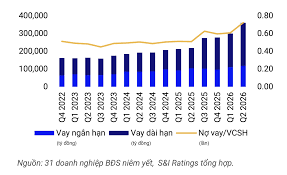
The real estate sector in Vietnam is experiencing a substantial increase in debt, as indicated by recent data from S&I Ratings. By the end of June, the debt-to-equity ratio for the entire industry climbed to 0.72, marking the highest level in 15 quarters. This rise signifies that for every 1 dong of equity, there is 0.72 dong of debt, highlighting a growing dependence on borrowed funds.
As of June, the total outstanding debt for listed real estate companies reached approximately 360.24 trillion dong, an increase of more than 20% or nearly 60.9 trillion dong compared to the end of March. This surge in debt is primarily attributed to ongoing project developments and the recovery of capital demands within the sector.
The long-term debt ratio has also increased, now accounting for 67.3% of total debt, up from 63.1% in the previous quarter. This indicates that the funds are primarily being used for project implementation and development rather than short-term liquidity pressures. Notably, Vinhomes (VHM) has borrowed an additional 50 trillion dong mainly for new project investments, followed by Novaland (NVL), which increased its debt by over 4 trillion dong.
In a report released in early August, SSI Research noted that many banks are ramping up lending in the real estate sector. Banks with significant credit growth potential, such as MB, VPBank, HDBank, Techcombank, TPBank, and VIB, have increased their lending to property developers by 22% in the second quarter compared to the previous quarter. This trend reflects a return to core lending segments, which have traditionally been their strength.
However, access to capital is becoming increasingly selective, as banks are exercising caution with projects that have incomplete legal frameworks or high leverage. The Ministry of Construction's report on housing and the real estate market for the second quarter indicates that credit distribution for real estate business activities is uneven among companies, with access varying based on financial capacity, project legality, and cash flow generation ability.
In the bond market, the second quarter saw a strong recovery in issuance and secondary trading. S&I Ratings calculated that in the first half of the year, the total issuance value reached approximately 275.4 trillion dong, with real estate accounting for 128.2 trillion dong, or 46.5%. In the second quarter alone, the real estate sector issued 102.4 trillion dong, a 228% increase year-on-year, representing 43.8% of the market. Notably, nearly 84% of this issuance came from three major players: Vingroup, Masterise, and Sun Group.
The average bond issuance interest rate in the real estate sector has shown a clear upward trend this year, averaging around 11.4% annually in the second quarter and 11.3% in the first half, with peaks of 12.5% and 13.5% respectively. The risk lies in the increasing leverage across various channels. In addition to bank loans, major investors are also using bonds to supplement project funding, which will increase financial obligations in the coming years.
S&I Ratings forecasts that real estate bonds maturing in 2027 will exceed 156.5 trillion dong, a 16% increase from this year. With new issuance interest rates above 11% annually, the cost of refinancing could become a significant financial pressure for companies with high leverage.
On a positive note, BIDV Securities (BSC) believes that the recovery in sales during 2025-2026 is creating a substantial backlog for developers, thereby supporting cash flow and profits in the coming years. They project that the net profit after tax for the monitored real estate companies will reach 76.27 trillion dong in 2026, a 36% increase, and 91.89 trillion dong in 2027, a 21% increase.