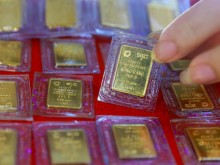
Gold Prices Surge Towards $4,200/ounce
Gold prices are on the rise, aiming for the significant threshold of $4,200 per ounce. Recent market trends

Gold prices are experiencing a significant increase, driven by a surge in demand as investors look for safe-haven assets amidst rising financial uncertainties in the United States. The ongoing concerns regarding fiscal risks and the implications of U.S. monetary policy have led to a notable influx of capital into the precious metal.
Recently, gold prices rose by an additional $48 per ounce in futures trading, while spot gold prices increased by nearly $49 per ounce, extending the upward trend that began last week. This increase has allowed gold to surpass a crucial technical resistance level of $4,692 per ounce, which corresponds to a 38.2% recovery from a previous decline.
Technically, gold is now targeting the next price point around $4,900 per ounce, representing a 50% recovery from earlier losses. The consistent breaking of significant price barriers indicates strong buying momentum, reinforcing the bullish trend for gold.
In the previous week, gold successfully overcame several critical resistance levels, including the 23.6% recovery point and various moving averages over 100 and 200 days. These technical milestones are closely monitored by investors to gauge market trends. The absence of a sell-off during this upward movement suggests that buying pressure remains robust, further solidifying the bullish outlook for gold.
Interestingly, the rise in gold prices comes despite a slight recovery in the U.S. dollar, which increased by approximately 0.14%. This indicates that the primary driver behind gold's current momentum is not solely currency fluctuations but also the heightened demand for protection against economic and financial risks.
While gold continues to climb, silver has shown a contrasting trend. Spot silver prices dipped to around $68.75 per ounce, while silver futures settled at $68.59 per ounce. This divergence between the two precious metals highlights silver's dual role as both a safe-haven asset and a crucial component in industrial applications.
The gold-to-silver price ratio is widening, suggesting that gold is outperforming silver in the short term. Historically, significant disparities between these two metals can set the stage for silver's recovery, although predicting the timing of such reversals remains challenging.
Currently, the gold market is closely watching macroeconomic indicators from the United States. Key factors such as July's personal consumption expenditures (PCE) inflation data, Nvidia's earnings report, and Federal Reserve Chairman Kevin Warsh's speech at the Jackson Hole conference are anticipated to influence interest rate expectations in the near future.
A signal from the Fed suggesting a potential easing of monetary policy or acknowledgment of challenges posed by the U.S. national debt, which stands at approximately $40 trillion, alongside persistent inflationary pressures, could provide additional support for gold prices. Conversely, a more hawkish stance from the Fed might prompt investors to take profits following the recent rally.
In addition to monetary policy considerations, geopolitical factors continue to bolster gold's role as a safe haven. Ongoing tensions related to Iran and the situation in the Strait of Hormuz remain closely monitored by the market. However, a recent decline in oil prices has somewhat alleviated concerns regarding inflationary pressures.
From a technical perspective, the $4,650 per ounce level is currently a critical resistance point for spot gold. A successful breach of this level could lead to targets of $4,772 per ounce and potentially $4,968 per ounce. Conversely, immediate support levels are at $4,594 per ounce and subsequently at $4,453 per ounce.
Overall, the bullish trend for gold remains dominant as buying pressure persists and supportive factors are still in play. However, developments from the Federal Reserve and upcoming U.S. economic data will ultimately determine whether the precious metal can continue its ascent towards the $5,000 per ounce mark or enter a phase of correction.
Note: Gold prices fluctuate based on various factors, including monetary policy, economic data, exchange rates, geopolitical situations, and market sentiment. The information in this article aims to provide insights into market trends and analysis, not investment advice.