
Hong Kong Auction House pulls suspected fake Vietnamese painting from sale
Sotheby's Hong Kong auction house has announced it will withdraw a lacquered wooden screen which is
HÀ NỘI — An international auction house has officially corrected the name of a late Vietnamese artist, following calls from art researchers and the wider community.
Asium, the first auction-style marketplace for Asian art, has confirmed its error in Lot 145, which was auctioned on 03.11.2020. They have now rectified the mistake, correcting the artist’s name from “Trần Bình Loc” to “Trần Tấn Loc”.
The official response from the auction house was prompted by a Vietnamese independent curator and art researcher in Singapore, Ace Le, in a Facebook post called 'The Misidentification of Trần Tấn Loc', which stirred up concern among Vietnamese art enthusiasts.
“This is a constructive and transparent response on Asium's part, which we highly appreciate. On behalf of the Vietnamese art community, we thank Asium for their swift action,” Le said.
In his post, the Vietnamese curator expressed his concern regarding the misidentification of the Vietnamese artist by several prestigious auction houses in the past decade.
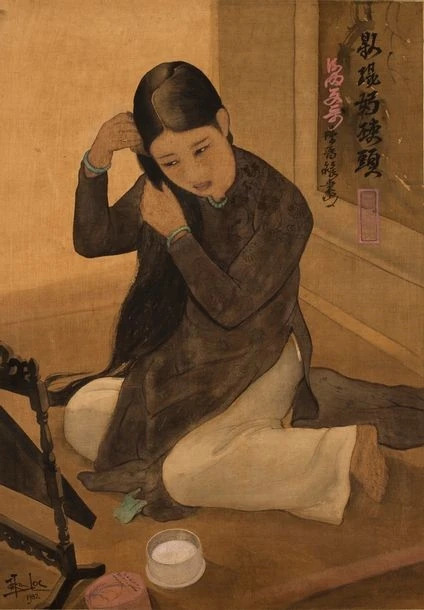
Particularly, in an upcoming sale on March 14 by French auction house Aguttes, the catalogue-cover work of Jeune Élegante Se Coiffant (1932) is attributed to the master Trần Bình Loc from École des Beaux-Arts de l'Indochine, which is estimated to go for between 80,000-120,000 Euros.
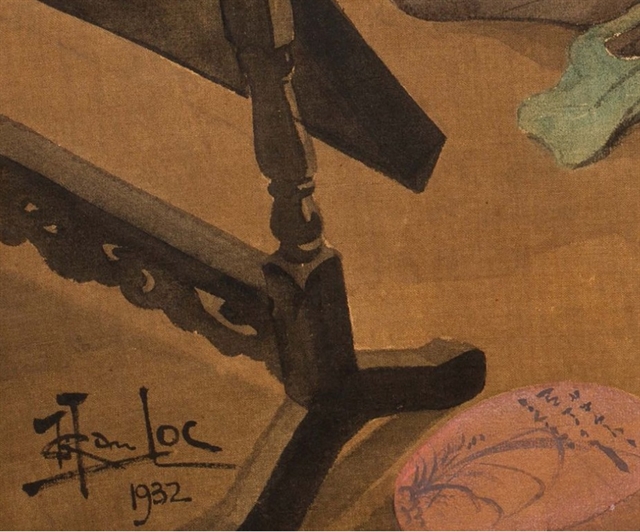
“However, a mere glance at the signature spells instant doubt: this is not a work by Trần Bình Loc, but another artist named Trần Tấn Loc. There is little public information on this artist."
Other auction houses, including Mutual Art, Lynda Trouve and Thierry de Maigret, have also used the name of Trần Bình Loc in their 2010, 2017 and 2020 auctions.
“Just via visual inspection, we could see that all of these lots bear the clear signature of ‘Tr Tan Loc’ – which could not have been mistaken for Trần Bình Loc,” he said.
The art specialist and his colleagues have also turned to a Han-Nom scholar and professional translator for consultation on the characters in the painting that are in Vietnamese Nom (Sino-Vietnamese).
According to him, the Nom words clearly read Trần Tấn Loc họa (Painted by Trần Tấn Loc), with a title Người Con Gai Trải/Chải Đầu (A maid combing hair), and the letters in the red mock-seal spelling Văn Thai, referring to the picture gallery named “Văn Thai” where he worked at in Ha Noi.
To make sure, they compared this work with another of the same theme and period, Deux Jeunes Femmes Peignant Leurs Longs Cheveux (1932) by Phung Văn Cừ, included in the 18.12.2020 sale by Boisgirard Antonini.
“Here the auction house wrongly spelt the artist’s name as Phung Van Cun.
“The calligraphy style in both artworks is similar, prompting us to conclude that indeed both pictures were sold in the same Văn Thai gallery in Ha Noi, which took the liberty to draw the artist’s credit, artwork title and poetry comments onto the finished works in 1932. This is an important finding.
“To conclude, the entire series of works attributed to Trần Bình Loc by various auction houses over the last decade indeed belong to Trần Tấn Loc instead,” Le said.
The art researcher, therefore, calls for auction houses to correct the current and past lots to rightfully credit the artist Trần Tấn Loc and, in the long run, continue to seek advice from Vietnamese art historians and researchers, especially those who could lend their expertise on Vietnamese and the Nom language.
“We hope that the auction houses will be open to constructive criticism. We could together strive to architect a healthy and credible Indochine marketplace,” he added.
By March 1, Aguttes had changed the name of the artist who painted Jeune Élegante Se Coiffant into Trần Tấn Loc; however, the year of his birth and death is still mistaken for Trần Bình Loc.
Biography
The issue of the Vietnamese artist’s misidentification was first raised by researcher Kevin Vương.
Upon insightful research to trace and reach out to the artist’s surviving family members, colleagues and friends, Kevin Vương finally arrived at a biography for Trần Tấn Loc, whose paintings and drawings had long been sold by auction houses and listed his work under the name Trần Bình Loc.
According to the Loc’s biography, that was written by Kevin Vương and published on luxuo.vn, the late artist (1906 – 1968) was born in Lủ Village, Thanh Trì District, Ha Noi. During his lifetime, he was a famous decorative painter in the capital city.
After four years of formal training, he graduated with a degree in Decoration from École Nationale de l’Artisanat in Ha Noi. In 1930, at the age of 24, he and his younger brother won prizes at a poster competition organised by the Director of the Indochina Beer and Ice Company.
During his life of artistic activities, he opened Tấn Loc Fine Art Advertising Company at number 29-31 Hang Đậu Street, specialising in painting advertisements that resonated throughout Indochina. Trademarks ranging from wine, confectionery, silk fabrics to bundles of chopsticks, pots and pans, even bags of mangosteen sent from the South are all drawn by him, with an easily identifiable logo.
In the 1940s, the artist was invited by the French Overseas Bank to design Indochina banknotes, famously the 1 and 20 Piastre notes. He also participated in drawing the National Emblem of Viet Nam. — VNS