HANGZHOU, China, Oct. 22, 2026 /PRNewswire/ -- An international symposium, "James Cahill's Legacy and Global Art History," together with its affiliated academic events commemorating the centenary of James Cahill, was hosted by China Academy of Art (CAA) at the Xiangshan Campus in Hangzhou on October 17–18, 2026. The events were as follows:
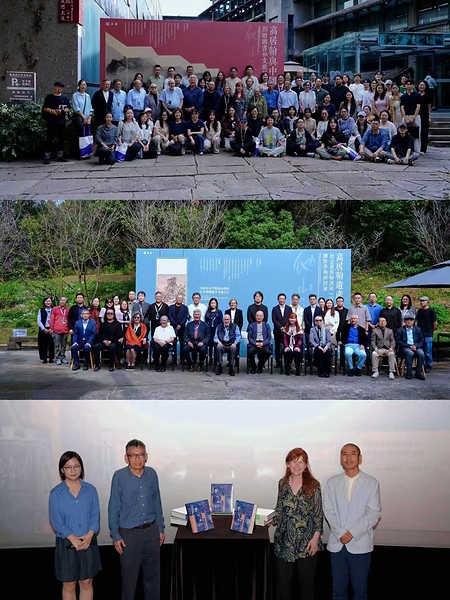
Group Photographs, James Cahill Centennial Commemoration Events
- James Cahill's Legacy and Global Art History: An International Symposium Commemorating the Centenary of James Cahill
- James Cahill and China Academy of Art: An Exhibition of Donated Books and Documents
- Book Launch of the Second Volume of James Cahill's Lecture Series on Chinese Painting History GAZING INTO THE PAST: Scenes from Later Chinese and Japanese Painting
- Premiere of the Documentary GAZING INTO THE PAST, THE UNBOUNDED VISION OF JAMES CAHILL
James Francis Cahill (1926–2014) was one of the most influential art historians and curators on Chinese and Asian art worldwide in the late 20th century. He was also among the first American art historians to visit China after President Richard Nixon's historic trip in 1972, traveling to China in 1973, and came back in 1977 as chairman of the Chinese Old Painting Delegation. He first established academic contact with China Academy of Art (then Zhejiang Academy of Fine Arts) in 1982 and devoted himself to collaborating with Chinese colleagues and friends to develop the academy's international exchanges in Chinese art and history. Since the mid-1990s, he, together with his family and students, had been donating books, archives, and visual materials on art history to the Department of Art History and the Library of CAA. In 1994, he became the first Pan Tianshou Chair Professor at China Academy of Art. Since the 1990s, his books about Chinese art have also been popular with general readers in China.
James Cahill was born on August 13, 1926, in Fort Bragg, California. The year 2026 marks the centennial of his birth. Telling the story of Chinese visual art to the world and promoting the study of Chinese art in a globalizing age—just as James Cahill did out of his deep belief in the universal value of traditional Chinese culture—is meaningful both intellectually and practically. That is why his memory still deserves our remembrance on this occasion at China Academy of Art in Hangzhou, which he regarded as his hometown in China.
Source: China Academy of Art


