Seihakusai Festival in Nanao: A Living Tradition at the Heart of Noto
Seihakusai Festival Information— Hikiyama (Dekayama) Ritual Dates: May 3 (Sun) – May 5 (Tue), 2026 Location:
Loading...
KATSUYAMA, Japan, July 28, 2026 /PRNewswire/ -- Kanazawa Biyori, a regional media outlet rooted in the Hokuriku region of northwestern Japan — one that reports not only on famous landmarks but on the culture that still breathes through this region — turns its lens toward a gathering of prehistoric giants. The Fukui Prefectural Dinosaur Museum's special exhibition for 2026, titled in Japanese Ryūkyakurui: Daichi o Yurugashita Chijō Saidai no Ikimono and rendered in English by Kanazawa Biyori as "Sauropods: The Largest Creatures Ever to Walk the Earth," runs through November 3 and explores how these long-necked, long-tailed plant-eaters grew to such extraordinary size.
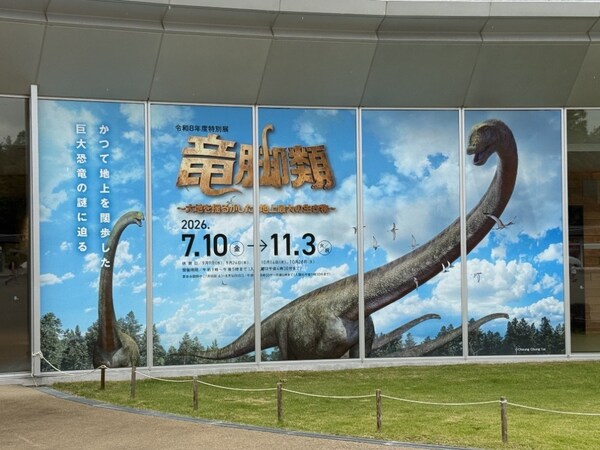
A Skeleton Preserved as It Was Found
The centerpiece is Xinjiangtitan, a sauropod from China displayed in situ, preserving the arrangement in which its bones were excavated rather than reconstructing the skeleton from scattered remains. The cast measures approximately 19 meters in length. The specimens displayed alongside it, drawn from Japan, China and Spain, include fossils being shown in Japan for the first time and together explore a central question: how did any land animal grow this large?
A World First, and Fossils From Across Japan
Also on view is Iniestapodus, a footprint fossil exhibited as a cast and, according to the organizers, displayed publicly for the first time anywhere in the world. Alongside it are sauropod fossils — some of them actual specimens rather than casts — from every locality in Japan where such remains have been discovered, gathered together for the first time. Among them is Tambatitanis.
A Summer Project and a Lifelong Fascination
Throughout the exhibition, the museum offers guided tours led by its own researchers as well as lectures by visiting specialists. The exhibition also provides an ideal subject for the summer research projects commonly assigned to Japanese schoolchildren, making it a destination for families as much as for lifelong dinosaur enthusiasts. An exhibition of this scale and scope could be realized only at one of the world's leading dinosaur museums.
Standing Beneath Nineteen Meters of History
Kanazawa Biyori visited the exhibition. Until we entered the hall, "19 meters" was merely a number — these animals had existed for us only in books and illustrations. The museum bridges that gap with video installations, dioramas and skeletal models that allow even visitors with no background in paleontology to grasp the scale of what stands before them.
One display in particular remained with us: restored forelimbs presented side by side at full scale. Brachiosaurus, the largest, reaches 5.0 meters, while Fukuititan stands at 1.8 meters — a difference immediately apparent to the eye. Beyond that are world-premiere exhibits, fossils excavated from sites across Japan, and specimens brought from China and Spain. The exhibition traces the evolution of these animals, the excavation of their remains and the lives they once led, in a sequence so absorbing that we lost track of time.
Why Kanazawa Biyori Tells This Story
Hokuriku is often reduced to a handful of familiar images — gardens, hot springs and gold leaf. Yet this coast also preserves the ground from which Japan's dinosaurs emerge, and it is home to a museum regarded as one of the finest of its kind in the world.
We are reporting on this exhibition not simply as another destination to add to a travel itinerary, but because standing beneath a 19-meter skeleton fundamentally alters one's sense of scale in a way no photograph can capture. That experience, we believe, deserves to be shared with readers far beyond these shores.
Special Exhibition Ryūkyakurui: Daichi o Yurugashita Chijō Saidai no Ikimono (English rendering by Kanazawa Biyori: "Sauropods: The Largest Creatures Ever to Walk the Earth")
Dates: Friday, July 10 – Tuesday, November 3, 2026 (November 3 is a national holiday in Japan)
Hours: 9:00–17:00, last entry 16:30. Extended summer hours apply from Saturday, July 18, to Sunday, August 16: 8:30–18:00, last entry 17:30.
Closed: Wednesday, September 9; Thursday, September 24; Wednesday, October 14; Wednesday, October 28
Admission:
Adults: ¥1,800 (¥1,600 for groups of 30 or more)
High school and college students: ¥1,600 (¥1,300)
Elementary and junior high school students: ¥1,000 (¥800)
Visitors aged 70 and over: ¥1,000 (¥800)
Preschool children: Free
Tickets: Timed-entry tickets are generally required and should be purchased in advance. Same-day tickets are available at the museum only while capacity remains, and telephone reservations are not accepted. Advance purchase is strongly recommended.
Venue: Fukui Prefectural Dinosaur Museum, Special Exhibition Room, 51-11 Terao, Muroko-cho, Katsuyama-shi, Fukui 911-8601, Japan
Parking: Available
Official site: www.dinosaur.pref.fukui.jp/special/sauropod2026/
Media Contact
Kanazawa Biyori Co., Ltd.
Sunpia Izumigaoka 511, 255 Fushimishinmachi, Kanazawa, Ishikawa 920-0964, Japan
Email: [email protected]


