APO Productivity Outlook 2026 Highlights Energy Efficiency as a Driver of Productivity Growth
Notified -
TOKYO, Oct. 07, 2026 (GLOBE NEWSWIRE) -- The Asian Productivity Organization (APO) has released the 19th edition of the APO Productivity Databook, which provides harmonized comparisons of Asia’s economic growth and productivity from 1970 through 2024, with projections through 2035. The 2026 edition presents economic growth and labor productivity indicators for 38 Asian economies: the 21 APO member economies (APO21) and 17 nonmember economies, collectively referred to as Asia38.
For APO member economies, the Databook reports that average annual growth in per-hour labor productivity moderated from 2.9% in 2015–2019 to 2.5% in 2019–2024, while average annual total factor productivity (TFP) growth remained at 1.0% in both periods. Beyond these aggregate measures, the Databook examines changes in productivity, industrial structure, and the composition of demand within and across APO member economies.
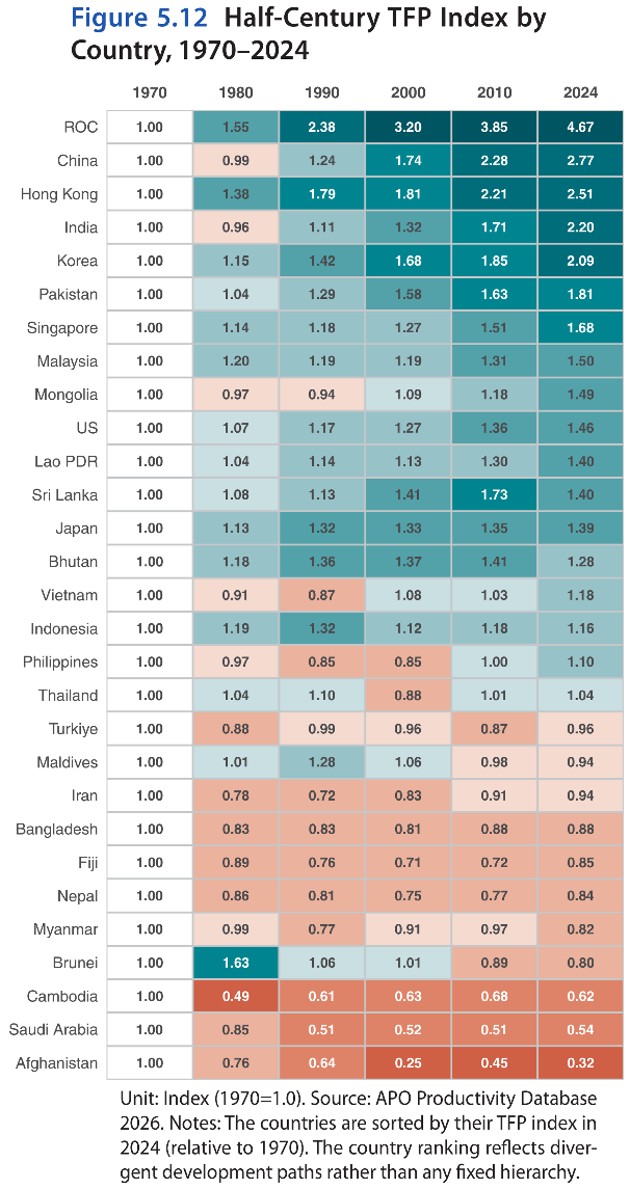
Built on the APO Productivity Database 2026, the Databook develops full productivity accounts for APO21 together with seven nonmember economies: Afghanistan, Bhutan, Brunei, the People’s Republic of China, the Maldives, Myanmar, and Saudi Arabia. Together, these 28 economies are referred to as Asia28. Saudi Arabia is included in the full accounts for the first time, while Kazakhstan, Kyrgyzstan, Tajikistan, Turkmenistan, and Uzbekistan are newly covered in the broader labor productivity indicators.
The 2026 edition incorporates revisions to official national accounts and related statistics released up to May 2026. The APO Productivity Database 2026 incorporates quality-adjusted labor input estimates from the Asia Quality-adjusted Labor Input Database 2026 and stock estimates of land and mineral and energy resources from the Asia Natural Resources Database 2026. In addition to individual economy accounts, the database provides regional productivity accounts for ASEAN6, APO21, Asia28, CLMV (Cambodia, Lao PDR, Myanmar, and Vietnam), East Asia, and SAARC (South Asian Association for Regional Cooperation), identifying the contributions of capital input, labor input, and TFP to each group’s economic growth. Together, these sources strengthen the evidence available to policymakers, researchers, and practitioners developing productivity strategies.
Highlights of the APO Productivity Databook 2026
The APO Productivity Databook 2026 is available in both digital and print formats and can be accessed and downloaded for free from the link below.
http://doi.org/10.61145/JHLU9970
The APO Productivity Database 2026 contains full productivity accounts for APO21 and seven nonmember economies and is available at https://www.apo-tokyo.org/productivitydatabook/.
About the APO
The APO is a regional intergovernmental organization dedicated to improving productivity in the Asia-Pacific region through mutual cooperation. Established in 1961, the APO supports its member economies through policy advisory services, capacity building, and knowledge sharing to promote sustainable socioeconomic development.
Contact: [email protected]
Website: https://www.apo-tokyo.org
Photos accompanying this announcement are available at
https://www.globenewswire.com/NewsRoom/AttachmentNg/fe8a378d-2df9-450f-9e6f-95f5586f172c
https://www.globenewswire.com/NewsRoom/AttachmentNg/866ac185-16cb-4467-b2ec-a989f04cd5d8