While diabetes is commonly associated with humans, the disease also affects dogs and cats. Its impact on the quality of life of both pets and their owners is often greater than many people realize.
BANGKOK, Sept. 2, 2026 /PRNewswire/ -- In dogs, diabetes is similar to Type 1 diabetes in humans, in which the beta cells in the pancreas that produce insulin are destroyed or lose their function, resulting in a severe insulin deficiency. In cats, the disease is more similar to Type 2 diabetes, in which insulin resistance develops or the pancreas produces insufficient insulin, leading to abnormally high blood sugar levels.
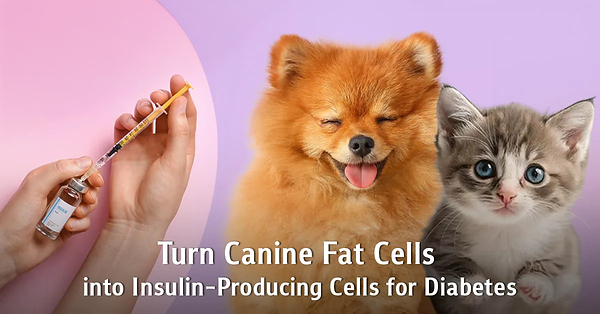
From Canine Fat Tissue to Insulin-Producing Cells
Veterinary studies have reported that diabetes is found in approximately one in every 300 dogs and cats receiving treatment, although the rate varies among populations and regions. While the number may seem relatively small, diabetes places a significant burden on both affected animals and their owners. Today, dogs with diabetes require daily insulin injections for the rest of their lives. This is the challenge that a research team from the Faculty of Veterinary Science, Chulalongkorn University, has been working to address over the past decade. Drawing on its expertise in stem cells and regenerative veterinary medicine, the team has pursued new approaches to treating diabetes in companion animals. Most recently, the team succeeded in developing stem cell technology from canine adipose (fat) tissue that may pave the way toward a lasting treatment for diabetes in dogs and cats.
How the "Canine Fat-Derived Beta Cells" Research Began
After gaining extensive research experience in stem cells and bioengineering in the United States, Assoc. Prof. Chenphop Sawangmake, DVM, PhD, established the Veterinary Stem Cell and Bioengineering Innovation Center (VSCBIC) at the Faculty of Veterinary Science, Chulalongkorn University, in 2013. Among the center's early research priorities were diseases in companion animals that have no cure, particularly canine diabetes, which requires lifelong treatment.
"Why should we settle for managing the disease when advances in stem cell science and biomedical engineering may open the door to a genuine cure?" said Assoc. Prof. Chenphop, recalling the idea that inspired the Canine Fat-Derived Beta Cells research project, which aims to transform the treatment of canine diabetes from lifelong management to a cure.
"We developed a treatment approach by integrating expertise in stem cell technology, tissue engineering, and genetic engineering."
Why Canine Adipose Tissue?
Selecting the right source of stem cells was a critical part of the research. The team spent five to six years comparing cells derived from various sources, including bone marrow, oral tissue, and adipose (fat) tissue, before concluding that adipose tissue offered the most practical solution.
Dr. Saranyou Oontawee, a member of the research team, explained that mesenchymal stem cells (MSCs) derived from adipose tissue offer several advantages over those obtained from bone marrow or umbilical cord tissue. Adipose tissue is easy to collect, highly safe, and, most importantly, yields far greater numbers of stem cells—up to 500 times more than bone marrow. In addition, the tissue can be collected during routine spay or neuter procedures, making the technology more accessible to pet owners without excessive costs.
"Stem cell therapy is no longer out of reach. A small amount of adipose tissue collected during a routine surgical procedure could become the starting point for a treatment that transforms a dog's life."
– Dr. Saranyou Oontawee
How Can Adipose Tissue Cells Be Turned into Insulin-Producing Cells?
Beta cells are found in the pancreas and play a key role in producing insulin to regulate blood sugar levels. In dogs with diabetes, these cells are destroyed or lose their function. The research team's goal, therefore, was to create replacement beta cells from stem cells isolated from adipose tissue.
While the concept sounds straightforward, putting it into practice is highly complex. The researchers adopted a "nature-inspired" approach, mimicking the processes that occur during embryonic development, when stem cells gradually differentiate into various organs through a series of developmental stages. In essence, the team sought to "teach" the cells to take on a new role.
The process relies on two main mechanisms. The first is cellular reprogramming, in which genes that control beta-cell development are introduced directly into stem cells. The second involves controlling the cellular environment by adding a sequence of stimulating biomolecules to carry the cells to their desired shape and function. The research team combined the two mechanisms to obtain the highest quality and quantity of cells.
The resulting cells were capable of secreting insulin at levels comparable to those of the natural pancreas. The researchers also detected glucagon secretion, suggesting that the engineered cells possessed the complete cellular characteristics of pancreatic islets (Islets of Langerhans). In addition, the cells demonstrated the ability to lower blood sugar levels in animal models.
From a Lifetime of Treatment to the Hope of a Cure
The concept of transplanting insulin-producing cells to replace lost beta cells in animals is no longer just a distant dream. Evidence from international studies has shown that donor beta-cell transplantation can allow some people with diabetes to remain free from insulin injections for years and lead normal lives.
"If these insulin-producing cells continue to show promising results, our goal is to transplant them to replace the beta cells lost to diabetes in companion animals, restoring the body's ability to produce insulin naturally."
– Assoc. Prof. Chenphop
He also shared the results of the team's animal studies. "The findings have been encouraging. Blood sugar levels improved significantly, and the treatment remained within acceptable safety limits. This marks an important step forward, demonstrating that the concept can work in practice and not just in theory."
Regenerative Medicine and the Future of Disease Treatment in Companion Animals
As regenerative medicine continues to advance and gain wider public attention, the research team faces two challenges simultaneously. The first is developing cells that are effective, safe, and stable after transplantation. The second is building public trust by demonstrating that the research adheres to rigorous scientific standards, ensuring that any treatment brought into practice is both effective and safe.
"Today, exaggerated claims about stem cell therapies are widespread in the marketplace, despite the lack of scientific evidence supporting their effectiveness and safety," said Assoc. Prof. Chenphop. "One of our priorities is to help the public understand that stem cell therapy is not a miracle cure for every disease. People need to make informed decisions and critically evaluate whether the information they receive is supported by credible evidence."
Assoc. Prof. Chenphop added that even if cell-based therapy for diabetes eventually becomes a reality, the team would not see it as the end goal but rather the beginning of the next phase. The knowledge and techniques developed through this research could be applied to a wide range of diseases caused by organ degeneration, including disorders of the eye, bone, liver, and kidney, without having to start from scratch.
Moreover, some of this knowledge can be shared between veterinary and human medicine. In certain cases, animal models may provide insights that are difficult to obtain through conventional models used in human medical research, allowing some technologies and approaches to be translated directly between the two fields.
The Team's Current Research Progress
Eight years after the project began, the research has successfully demonstrated its potential in animal models. The team is now moving full speed ahead into the next phase of development.
"Our team is currently scaling up beta-cell production to the pilot scale, using microfluidics technology to generate millions of beta-cell clusters," said Dr. Saranyou Oontawee. "In practice, transplantation requires large numbers of beta cells that are robust, functional, and capable of surviving long-term after transplantation," said Dr. Saranyou.
The team is also pursuing a complementary approach through exosome therapy, which uses substances secreted by stem cells to help repair damaged pancreatic tissue. The results have shown that damaged pancreases can recover following exosome treatment, with outcomes that exceeded the researchers' expectations.
Assoc. Prof. Chenphop added: "Our next step is to further expand production capacity and begin studies in the target animal population." The team expects that within the next two to three years, it will be able to begin testing the therapy in dogs with diabetes and make the treatment available not long thereafter.
A New Hope for Companion Animals and Veterinary Medicine in Thailand
From a small laboratory established 13 years ago to a growing research center with a spin-off company and more than six petty patents, VSCBIC has demonstrated that Thai research can create technologies with global relevance.
"Our goal is to serve society by generating knowledge and developing technologies that people can truly rely on," said Assoc. Prof. Chenphop.
Dr. Saranyou added, "As part of the effort to advance companion animal health technologies in Thailand—particularly Exosome Therapy, an area in which Thailand is currently at the forefront. What gives us the greatest sense of pride is seeing our research translate into meaningful improvements in the lives of pets and their owners."
In closing, Assoc. Prof. Chenphop noted that the team continues to welcome young scientists and veterinarians who are interested in joining its research efforts or pursuing careers in regenerative medicine. The field is rapidly growing and needs the energy and commitment of the next generation of researchers. For pet owners whose animals suffer from conditions that are difficult to treat, regenerative medicine may offer new possibilities in the not-too-distant future.
For more information on regenerative medicine and animal stem cell technology, visit The research team
- Website: www.cuvscbic.com
- Spin-off http://www.bioinkcu.com/
- CU Innovation Hub website: https://cuihub.chula.ac.th/?lang=th
- Faculty of Veterinary Science, Chulalongkorn University website: https://www.vet.chula.ac.th/
Continue reading a full article on the website: https://www.chula.ac.th/en/highlight/421557/
Chulalongkorn University has been ranked Thailand's No. 1 university for the 17th consecutive year (since 2009) in the newly released QS World University Rankings 2026. The university is ranked 221st in the world and places among the world's Top 100 in two key indicators: Academic Reputation (89th) and Employment Outcomes (64th).
Source: Chulalongkorn University


