CGN Open Day Goes Global: Five Countries, One Green Future
PARIS, May 22, 2026 /PRNewswire/ -- On 21 May, marking the United Nations World Day for Cultural Diversity
Loading...
 |
Drilling Highlights:
VANCOUVER, BC, Aug. 26, 2026 /PRNewswire/ -- Xcite Uranium Inc. (CSE: XRI) ("Xcite" or the "Company") is pleased to report that the first three drill holes completed at Don Lake Project ("Don Lake" or the "Project") have intersected multiple zones of anomalous radioactivity.
The Don Lake uranium project is located near Uranium City, Saskatchewan, and hosts near surface uranium mineralization as well as a past producing uranium mine. The project is prospective for Beaverlodge style, basement hosted and unconformity hosted uranium mineralization.
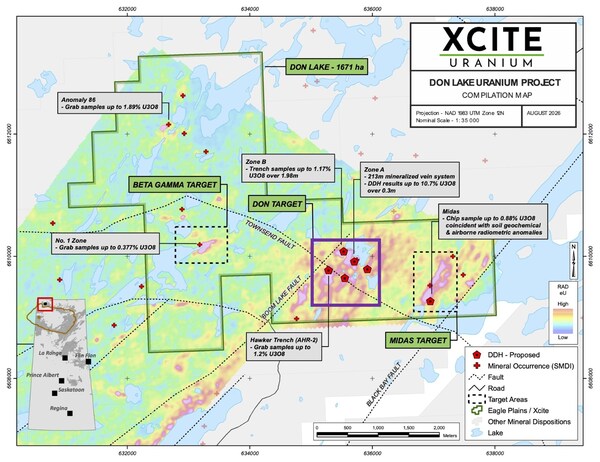
Don Lake Compilation Map
Geological key features from drilling:
Table 1 Drill Information
Hole ID | Zone | Azimuth | Dip | Total |
DN26001 | Don Main A Zone | 80 | -45 | 96 |
DN26002 | Don Main A Zone | 50 | -45 | 111 |
DN26003 | Don Main A Zone | 355 | -45 | 105 |
Figure 1 Zone A Update Map
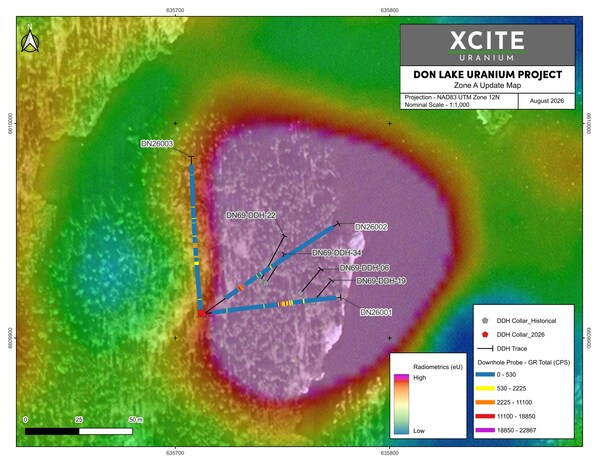
Table 2 2026 Drill Results
Downhole Gamma Probe 1,2 | Hand Held | |||||||
Hole | From | To | Width | Max | Average over | Depth | (CPS) | |
DN26001 | 54.93 | 56.83 | 1.9 | 27474 | 11571 | 55 | 51978 | |
57.53 | 58.23 | 0.7 | 8844 | 3813 | ||||
58.93 | 62.83 | 3.9 | 34254 | 7649 | ||||
including | 59.33 | 60.43 | 1.1 | 21096 | 11151 | |||
including | 61.43 | 62.33 | 0.9 | 34254 | 13428 | |||
DN26002 | 31.13 | 33.83 | 2.7 | 33940 | 8186 | 32.5 | 18000 | |
34.83 | 35.93 | 1.1 | 23923 | 11753 | ||||
49.63 | 50.03 | 0.4 | 2320 | 1882 | ||||
57.93 | 58.53 | 0.6 | 3004 | 2058 | ||||
DN26003 | 10.03 | 10.63 | 0.6 | 2060 | 1000 | |||
33.53 | 35.73 | 2.2 | 3850 | 1450 | ||||
38.53 | 39.73 | 1.2 | 10320 | 2700 | ||||
45.33 | 48.43 | 3.1 | 7830 | 1920 | ||||
52.53 | 53.03 | 0.5 | 4000 | 2000 | ||||
72.13 | 72.63 | 0.5 | 6800 | 2900 |
All depths and intervals are meters downhole, true thicknesses cannot yet be determined. Geochemical assays of drill core samples are pending.
1 Radioactive anomaly intervals are defined statistically at greater than 3 times average background counts: (i) at >800 counts per second (cps) measured with a Radiation Solutions BGO Super Spec ("RS-230") hand held Gamma Ray Spectrometer, or >900 cps measured with the Mount Sopris ("2SNA-1000") down hole spectral gamma probe, (ii) is accompanied by structure, hydrothermal alteration, or uranium mineralization typical of Beaverlodge type, or basement-hosted Athabasca unconformity type related uranium deposits, and (iii) spectrometric analyses by RS-230 or 2SNA-1000 probe indicates uranium to be the dominant source. |
2 Radioactivity is total gamma in counts per second (cps) measured downhole via the Mount Sopris 2SNA-1000 spectral gamma probe with data collected at 10cm intervals |
3 Peak radioactivity is total gamma in counts per second (cps) from surface drill core measured with a RS-230 hand-held spectrometer |
The 1500m, 14-hole program is testing for structurally-controlled uranium mineralization defined by both historical work and results from the 2025-2026 field programs. The program will consist of 1500m of diamond drilling, with 14 holes from 6 different pad locations. The 2026 drilling was contracted to Apex Drilling with crews based out of Uranium City.
Select drill core photos are provided in Figure 4 and Figure 5.
"Intersecting this level of near-surface anomalous radioactivity in the first three holes of the 2026 drill program demonstrates the prospectivity and underexplored nature of the Don Lake Uranium Project. We believe that our meticulous targeting approach, combined with our Uranium City summer work program, will unlock the entire Beaverlodge district's potential," said Jean-Francois Meilleur, President and CEO of Xcite Uranium.
The first three holes at Don Lake were completed in the A Zone area. Historical exploration, including fourteen trenches and 20 shallow drill holes, has outlined anomalous uranium mineralization over approximately 213m of strike length.
All of the drillholes intersected mainly gabbroic gneiss with moderate to strongly developed quartz veining, silicification +/-potassic alteration, and hematization. Other rock types include semi-pelite gneiss, and rare mafic dykes. Anomalous radioactivity is generally associated with the gabbroic gneiss.
The 2026 drilling program is testing for shallow, structurally-controlled uranium mineralization west of the Black Bay Fault, and north of the Townsend Fault, within the Don and Midas Targets. The holes are aligned to target the intersection between NE-trending and NW-trending structures. In the Don Target area, the drilling will test for extensions of high-grade uranium mineralization beneath the A, B, C Zone trenches and the Hawker trenches. At the Midas zone, drilling will target the source of the coincident 2026 uranium geochemical anomalies, and the strong anomaly defined by the 2026 radiometric survey.
Figure 2 DN26001 Section
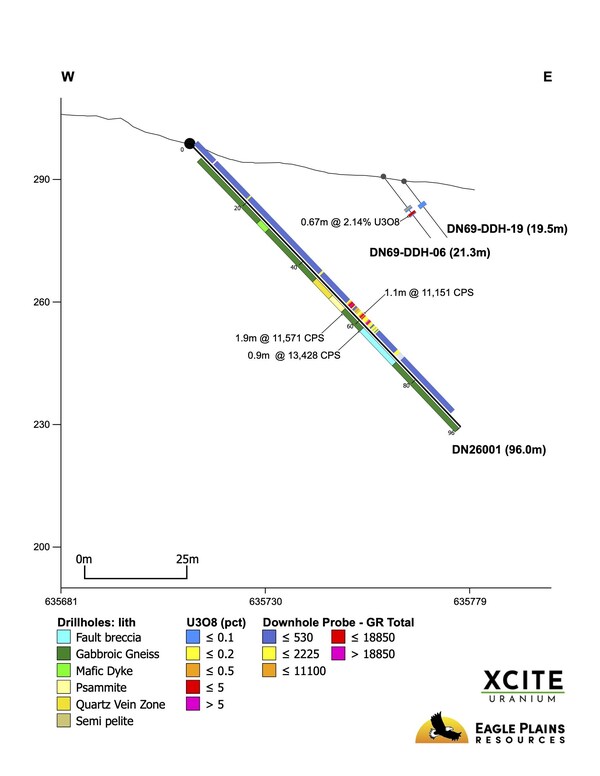
Figure 3 DN26002 Section
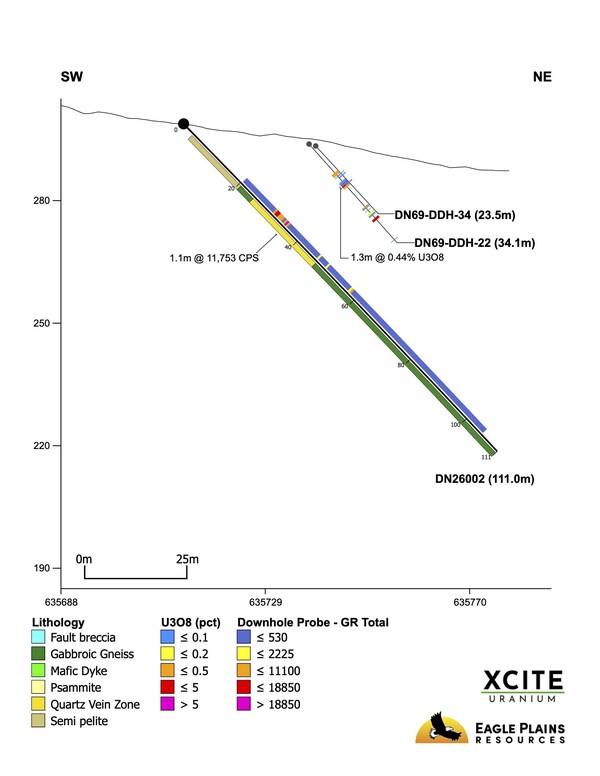
Figure 4 DDH DN26001 55.0m:
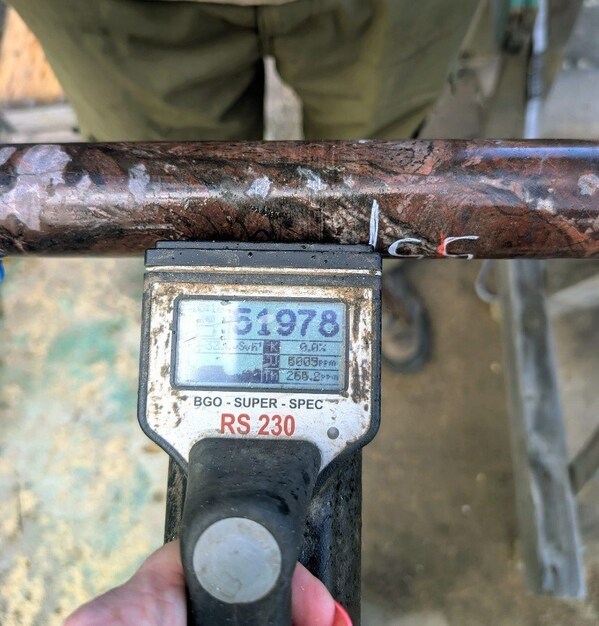
Description: Mineralized Psammite / Gabbroic Contact. Uranium mineralization hosted in fractures/veinlets associated with intense hematite and silica alteration.
Figure 5 DDH DN26002 32.5m:
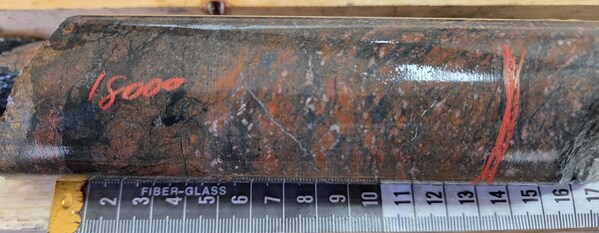
Description: Hematite and Kspar Altered Gabbro Gneiss with Yellow Uranium Oxide
Don Lake Project Highlights
The approved 2026 budget for Don Lake is approximately $1.1 million, consisting of $200,000 in fieldwork (completed) and $900,000 allocated for drilling. All work is managed by TerraLogic Exploration Inc.
About the Don Lake Project
The road accessible 1671ha project overlies 12 Saskatchewan Mineral Deposit Index ("SMDI") occurrences associated with Beaverlodge-type basement hosted uranium mineralization.
The property is transversed by the parallel, northeasterly-striking Boom Lake and Black Bay Fault, the latter of which is a regional structure that is inferred to control uranium mineralization in the Beaverlodge camp. In the southeast corner of the property Martin Group sediments form an unconformable contact with older Tazin Group gneisses, along the hanging wall of the Black Bay Fault.
Uranium mineralization at Don Lake is structurally controlled, occurring as pitchblende hosted in fractures and veins associated with faults and shear zones, and often associated with graphite and sulphides.
Three zones of radioactivity and U mineralization have been identified at the Don Lake A, B and C Zones (SMDI 1393), which has been traced by historical drilling and trenching over approximately 525m.
Zone A is a vein system with a length of 213.4 m, that crosses the trend of a northeast-striking lineament. Fourteen trenches and 20 shallow drill holes have been completed over the zone. Analytical results range from trace values up to 8.57% U3O8 over 0.91m and 2.86% U3O8 over 0.61m in trenching and 10.7% U3O8 over 0.3m and 2.14% U3O8 over 0.67m in drilling (AF74N10-0422).
Zone B, positioned to the northwest and interpreted to be a continuation of the mineralized trend observed at Zone A, has seen 12 shallow diamond drill holes and 20 trenches completed. Trench sampling reported grades as high as1.17% U3O8 over 1.98m, with drilling results including 0.71% U3O8 over 0.34m and 0.64% U3O8 over 0.3m. The uranium mineralization occurs in series of veins and fractures.
Zone C is positioned to the southeast of Zones A and B and further defines the NW-SE mineralized trend. 6 shallow drillholes and 9 trenches have been completed at Zone C, where trench samples returned from trace amounts up to 3.02% U3O8 over 0.61m and drilling intercepts included 0.80% U3O8 over 0.3m and 0.85% U3O8 over 0.52m.
At Radioactive Occurrence 50-CC3-10 and -44 (SMDI 1383), and the Midas Cu-U Showing (SMDI 1384) pitchblende occurs as in shears associated with the Crackingstone Fault. Showings associated with the Townsend Fault Uranium Showings (SMDI 1385) host pitchblende in fracture splays and breccia zones. A 10 ft (3.1 m) channel sample taken across a width of 1.0 ft (0.30 m) assayed 1.63% U3O8. (AF74N10-0056).
At the A.R. Hawker Trench ARH-2 (SMDI 2116) structurally controlled uranium and sulphide mineralization is associated with net textured quartz veins. Grab samples from trenches and surface showings returned from trace values up to 1.2% and 0.78% U3O8 (AF74N10-0453).
Don Lake History
Anomalous radioactivity at Don Lake was first noted by the Geological Survey of Canada in 1948, with the first claims recorded later that year by the Eldorado Mining and Refining Company. In 1950, Aurora Yellowknife Mines identified 28 radioactive occurrences on the property, including the 50-CC3-10 and 50-CC3-44 (SMDI 1383), Midas Cu-U Showing (1384) and Townsend Fault Uranium Showings (SMDI 1385). The same year Eldorado completed three short diamond drill holes at the Don Lake Zone A showing (SMDI 1393), with hole D-1 returning 2.0% U3O8 over 0.6m from 49.7-50.3m (AF 74N10-0345).
Between 1948-1968, various operators conducted work within the current Don Lake tenure, including prospecting, scintillometer surveying, trenching and limited diamond drilling. Most of this work is poorly documented. The next significant work was by Matrix Exploration in 1969, who carried out prospecting, scintillometer surveying, trenching and the 1200m of diamond drilling in 37 holes at the Don Lake A, B, and C Zones. Trenching in the A Zone returned from trace values up to 8.57% U3O8 over 0.91m and 2.86% U3O8 over 0.61m. The best drill intercept was from Zone A, where hole 23 returned 10.7% U3O8 over 0.3m (AF 74N10-0422).
Between 1971-78 August Hawker, Matrix Exploration and Kodiak Developments carried out prospecting, scintillometer surveys, trenching, and ground geophysics on various areas of the current Don Lake tenure.
Parts of the property were covered by airborne geophysics flown by Greater Lenora Resources Corp in 1997 (EM) and by the Geological Survey of Canada and Saskatchewan Energy and Mines who contracted Sander Geophysics to obtain gamma-ray spectrometric, aeromagnetic and VLF-EM data in 2000, the last significant work on the property.
Uranium City project map
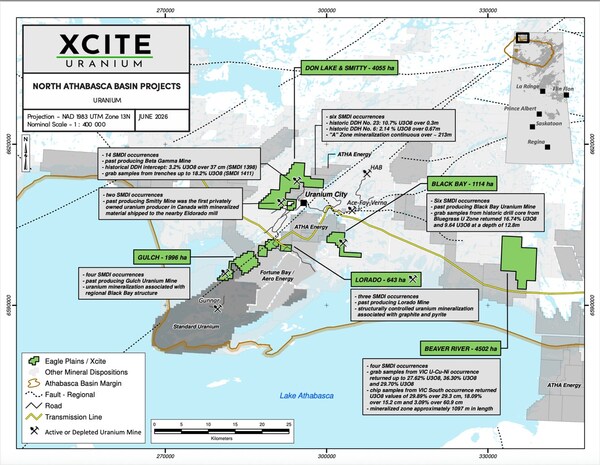
The Uranium City projects are included in a formal Exploration Agreement between Eagle Plains and the Ya'thi Nene Lands and Resource Office ("YNLR"), representing the Athabasca Denesułine First Nations of Hatchet Lake, Black Lake, and Fond du Lac, the Northern Hamlet of Stony Rapids, and the Northern Settlements of Uranium City, Wollaston Lake and Camsell Portage.
Rock grab samples are selective samples by nature and as such are not necessarily representative of the mineralization hosted across the property. Some of the above results were taken directly from the SMDI descriptions and assessment reports (AF) filed with the Saskatchewan government. Management cautions that historical results were collected and reported by past operators and have not been verified nor confirmed by a Qualified Person, but form a basis for ongoing work on the subject properties. Management cautions that past results or discoveries on proximate land are not necessarily indicative of the results that may be achieved on the subject properties.
Natural gamma radiation from rocks reported in this news release was measured in counts per second ("cps") using a handheld RS-230 spectrometer or 2SNA-1000 down hole spectral gamma probe. Readers are cautioned that measurements of total gamma on drill core are an indication of uranium content, but may not correlate with chemical assays.
About the Beaverlodge Uranium District
The Beaver River, Black Bay, Don Lake, Gulch, Lorado, and Smitty projects are located in the Beaverlodge District near Uranium City in the Lake Athabasca region of Saskatchewan. Occurrences of uranium mineralization are abundant in the Uranium City area and have been explored and documented since the 1940s. The Beaverlodge camp was the first uranium producer in Canada, with historic production of approximately 70.25 million pounds of U3O8 between 1950-1982, from ore grades averaging 0.23% U3O8. The two largest producers were the Eldorado Beaverlodge (Ace-Fay-Verna) mine and the Gunnar uranium mine. The Beaverlodge area has seen limited uranium focused exploration since the early 1990's.
The Uranium City area projects have potential for both Beaverlodge-style and basement-hosted uranium mineralization. Key features about the projects include:
These factors, along with the presence of a substantial uranium endowment in both basement rocks and Athabasca basin cover rocks, indicate excellent potential for economic uranium mineralization within the project. The mineralization, structures and alteration identified on the claims to date are strong indicators of the possibility of a nearby source for the uranium mineralization.
Qualified Person
Technical information in this News Release has been reviewed and approved by C.C. Downie, P.Geo., a director and officer of Eagle Plains, hereby identified as the "Qualified Person" under N.I. 43-101.
The technical content disclosed in this news release was reviewed and approved by Lorne M. Warner P.Geo, an independent Qualified Person as per National Instrument 43-101 - Standards of Disclosure for Mineral Projects.
On behalf of the Board of Directors of Xcite Uranium Inc.
Jean-Francois Meilleur, CEO
Neither the CSE nor its Regulation Services Provider (as that term is defined in the policies of the CSE) accepts responsibility for the adequacy or accuracy of this news release.
Cautionary Note Regarding Forward-Looking Statements:
Certain statements contained in this news release constitute "forward-looking information" as such term is defined in applicable Canadian securities legislation. The words "may", "would", "could", "should", "potential", "will", "seek", "intend", "plan", "anticipate", "believe", "estimate", "expect" and similar expressions as they relate to the Company, are intended to identify forward-looking information. All statements other than statements of historical fact may be forward-looking information. Such statements reflect the Company's current views and intentions with respect to future events, and current information available to them, and are subject to certain risks, uncertainties and assumptions, including, without limitation: the potential of the Company's mineral properties; the estimation of capital requirements; the estimation of operating costs; the timing and amount of future business expenditures; and the availability of necessary financing. Many factors could cause the actual results, performance or achievements that may be expressed or implied by such forward-looking information to vary from those described herein should one or more of these risks or uncertainties materialize. Such factors include but are not limited to: changes in economic conditions or financial markets; increases in costs; litigation; legislative, environmental and other judicial, regulatory, political and competitive developments; and exploration or operational difficulties. This list is not exhaustive of the factors that may affect forward-looking information. These and other factors should be considered carefully, and readers should not place undue reliance on such forward-looking information. Should any factor affect the Company in an unexpected manner, or should assumptions underlying the forward-looking information prove incorrect, the actual results or events may differ materially from the results or events predicted. Any such forward- looking information is expressly qualified in its entirety by this cautionary statement. Moreover, the Company does not assume responsibility for the accuracy or completeness of such forward-looking information. The forward-looking information included in this press release is made as of the date of this press release and the Company undertakes no obligation to publicly update or revise any forward-looking information, other than as required by applicable law.


