Consuls General in Guangzhou set sights on APEC 2026 in Shenzhen
GUANGZHOU, China, March 4, 2026 /PRNewswire/ -- News report from South. The Guangdong delegation is on the
Loading...
SHENZHEN, China, July 27, 2026 /PRNewswire/ -- The climate-trade nexus has become a defining challenge for the Asia-Pacific region — a topic that drew nearly 100 scholars, policymakers, and industry representatives to the Carbon Economics Salon Series in Shenzhen on June 16, just weeks ahead of the APEC Forestry Ministerial Meeting (July 27-28), where the green transition is expected to take center stage.
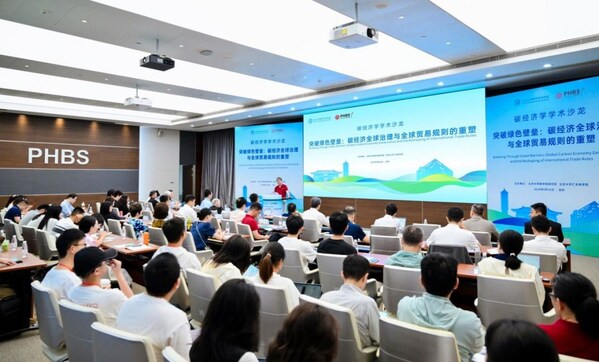
Themed "Breaking through Green Barriers: Carbon Economy Governance and the Reshaping of International Trade Rules," the salon was co-hosted by Peking University HSBC Business School (PHBS) and the Institute of Carbon Neutrality at Peking University (ICN-PKU). Discussions centered on three interconnected challenges: unilateral climate-related trade measures, uneven carbon market development, and the emerging role of AI in carbon governance — topics that also foreshadowed key themes on the APEC agenda in November.
In opening remarks, Piao Shilong, vice president of PKU and dean of ICN-PKU, and Hai Wen, vice chair of the PKU Council and founding dean of PHBS, underscored the urgency of building an inclusive global carbon governance system. Wang Pengfei, Boya Distinguished Professor at PKU and dean of PHBS, called for stronger carbon pricing mechanisms and market-based tools.
The keynote session featured Thomas J. Sargent, the 2011 Nobel laureate in economics and honorary director of the PHBS Sargent Institute of Quantitative Economics and Finance, who noted that uncertainty should encourage earlier investment in green R&D, emissions reduction, and forest conservation. Jiang Kejun, professor and head of the Thrust of Carbon Neutrality and Climate Change at HKUST (Guangzhou), identified 2030–2035 as a critical window for China's energy transition, driven by rapid growth in renewables and electric vehicles. Wu Dengsheng, professor at Shenzhen University, presented a review of carbon economics research, showing that China ranks second worldwide in publications.
Two roundtable sessions examined the spread of unilateral climate measures and their implications for global trade equity, as well as carbon market cooperation with the Global South. Zhang Haibin, Boya Distinguished Professor at PKU and vice dean of ICN-PKU, delivered closing remarks, reaffirming the importance of continued dialogue across disciplines.
The salon highlighted that carbon governance is increasingly shaped by trade rules, technology, and international coordination. It opened space for continued exchange between PHBS and ICN-PKU on global climate governance and China's "dual carbon" goals — topics that are expected to feature as APEC economies deepen their climate cooperation.


