BANGKOK, July 20, 2026 /PRNewswire/ -- When traditional lectures failed to make concepts such as carbon footprints and Life Cycle Assessment (LCA) easy to understand, Varoon Varanyanond, Industrial Partnership Advisor to the Center of Excellence on Petrochemical and Materials Technology (PETROMAT), Chulalongkorn University, turned to an unlikely teaching tool: a card game.
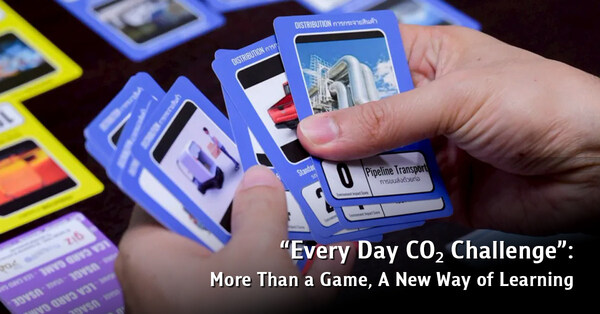
“Every Day CO₂ Challenge”: More Than a Game, A New Way of Learning
The result is Every Day CO₂ Challenge, a game designed to help players understand Life Cycle Assessment (LCA), an internationally recognized framework used to assess the environmental impacts of products throughout their life cycle. The game was developed under the MA-RE DESIGN project, supported by GIZ (Deutsche Gesellschaft für Internationale Zusammenarbeit).
Varoon was inspired to create the game after years of working as an Eco Design consultant and seeing how difficult LCA was to explain through conventional presentations. A lifelong game enthusiast, he believed that complex concepts could be learned more effectively through interaction, discussion, and play.
Designed for everyone from elementary school students to adults, the game challenges participants to collect cards with the lowest total environmental impact score. Action Cards add an element of surprise and strategy, while a Game Master encourages players to explain their choices and reflect on the environmental consequences behind them.
What sets the game apart is its emphasis on active learning. Players are encouraged to question assumptions and explore why certain materials, manufacturing methods, transportation choices, or disposal options result in higher or lower environmental impacts.
What began as a simple paper prototype has evolved into 50 bilingual (Thai-English) game sets made from recycled plastic, with support from the Thai Packaging Design Association (ThaiPDA) and GIZ. The game has been tested with students, educators, business professionals, and the public, receiving highly positive feedback.
Perhaps the most encouraging outcome is that players begin asking questions of their own: Why does one product have a higher score than another? Why does recycling matter? Why do transportation methods affect emissions differently? For Varoon, that curiosity is the real objective.
In an era when AI can provide information instantly, he believes the value of learning lies not only in access to knowledge, but also in discussion, shared experiences, and asking the right questions. Ultimately, Every Day CO₂ Challenge demonstrates that meaningful learning can begin with something as simple as sitting down together and playing a game.
Read more at https://www.chula.ac.th/en/highlight/415033/
Media Contact:
Chula Communication Center
Email: [email protected]
Source: Chulalongkorn University Communication Center


