Sungrow Powers Malaysia's Grid-Connected BESS to Strengthen National Power Grid Resilience
PAKA, Malaysia, July 7, 2026 /PRNewswire/ -- Sungrow, the globally leading PV inverter and energy storage
Loading...
 |
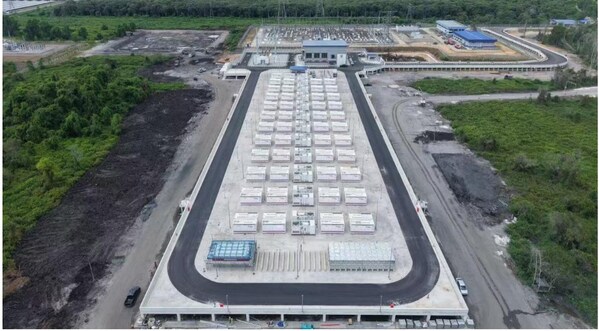
KUALA LUMPUR, Malaysia, July 10, 2026 /PRNewswire/ -- Sungrow, the globally leading PV inverter and energy storage system provider, successfully completed full-condition grid-forming (GFM) tests at the Santong 100 MW/400 MWh Battery Energy Storage System (BESS) project in Malaysia, demonstrating how advanced grid-forming technology can enhance grid resilience and support renewable energy integration in Southeast Asia.
Unlike conventional grid-following systems that rely on external voltage and frequency references, grid-forming technology enables energy storage systems to actively support grid stability through functions such as black start, islanded operation, virtual inertia, and voltage-frequency regulation.
At the Santong project, Sungrow completed four core dimensions of grid-forming (GFM) capability, including plant-level black start, seamless on-grid/off-grid switching, large-capacity transformer switching, and active grid support during grid-connected operation. The project represents a landmark grid-forming energy storage applications connected to Malaysia's national grid, providing a practical reference for renewable-heavy power systems across Southeast Asia.
Four Core Capabilities of System-Level Grid-Forming
Moving beyond traditional single-cabinet or limited-function tests, the project conducted full plant-level closed-loop validation across multiple operating conditions. It verified the grid-forming system's end-to-end capabilities, from active voltage build-up to grid-connected support.
Under a condition where the entire plant was completely de-energized with no external voltage or frequency reference, Sungrow's grid-forming PCS operated as an independent voltage source, autonomously performing zero-voltage start-up and rapidly establishing a stable AC bus voltage. Multiple converters simultaneously formed the grid and shared power equally, with no circulating current impact or device tripping throughout the process. This validated capability provides a practical pathway for utilities to strengthen grid recovery capabilities and improve resilience against large-scale outages.
The test verified seamless on/off-grid switching under two critical scenarios: instantaneous disconnection following a grid fault and re-synchronization during grid restoration. When the plant protection was triggered during full-load operation due to a grid fault, the system transferred from grid-connected operation to off-grid grid-forming operation without load interruption or significant voltage sag, maintaining continuous power supply to local loads.
The system demonstrated robust transient withstand capability under frequent large-capacity transformer switching, providing a practical reference for substation retrofits and the integration of energy storage converters with ageing transformers in Southeast Asia.
During the switching process, the bus voltage avoided severe collapse, and all equipment remained stable and grid-connected, helping lower the technical barriers tooverseas plant retrofitting and grid connection.
Under the weak grid conditions of Malaysia's East Coast with low short-circuit capacity, the system demonstrated its ability to provide virtual inertia, regulate voltage and frequency, and mitigate renewable power fluctuations. The validation achieved comprehensive coverage of key grid-forming functions and compliance with the latest TNB grid connection requirements.
The Santong plant completed all tests in a single run, backed by Sungrow's 20 years of system-level grid-forming expertise.
Sungrow adopts full-plant coordinated system architecture. Deeply integrated wind, solar and BESS control strategies eliminate logic conflicts arising from mixed-brand equipment assembly. Tailored to Malaysia's grid challenges, including high humidity, fluctuating grid strength, and multi-PV coupling resonance, its full-band oscillation suppression algorithm delivers superior power quality and system stability.
Photo Credit: Courtesy of Tenaga Nasional Berhad (TNB).
CONTACT:
WangLuly
[email protected]
15618330862


