HKSH Symposium on Advances in Cancer Management 2024 Breakthroughs in Cancer Management
HONG KONG, Jan. 2, 2025 /PRNewswire/ -- HKSH Cancer Centre organised the sixth "HKSH Symposium on
Loading...
Minimises Cardiopulmonary Concerns and Maintains Quality of Life
HONG KONG, July 7, 2026 /PRNewswire/ -- The HKSH Cancer Centre under HKSH Medical Group (HKSH) introduced proton therapy in 2023, covering a wide range of cancer types including breast, prostate as well as head and neck cancers, and has since accumulated about 940 cases of clinical data. Around 45% of its proton therapy treatments involve breast cancer patients receiving postoperative radiotherapy to reduce the risk of recurrence. Leveraging its clinical experience and innovative technologies in breast cancer proton therapy, HKSH has presented two clinical studies focusing on Chinese breast cancer patients at the Asia-Oceania Particle Therapy Co-operative Group 2025 (PTCOG-AO) and Particle Therapy Co-operative Group Annual Conference 2026 (PTCOG). Both studies are the first of their kind in Asia and further advance precision medicine aimed at helping patients "live with cancer while preserving quality of life."
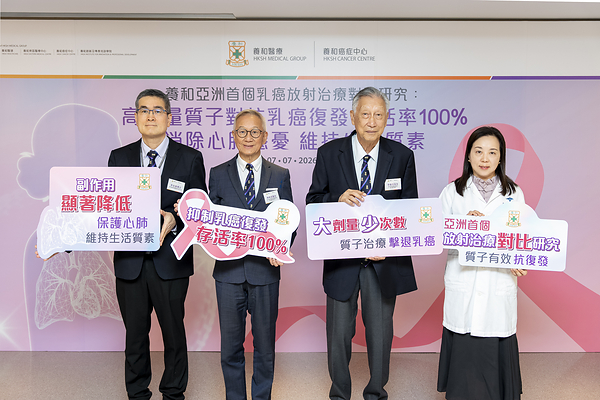
Mr. Wyman LI, Chief Operating Officer of HKSH Medical Group and Director of Hong Kong Sanatorium & Hospital, remarked, "Clinical research is the core driving force behind medical innovation. HKSH Proton Therapy Centre has demonstrated strong research depth on the international academic stage, injecting powerful momentum into precision cancer treatment for Hong Kong and the Greater Bay Area. At the same time, HKSH actively introduces cutting‑edge technologies, including being Asia's first to adopt photon‑counting CT for simulation and treatment planning. Shouldering the responsibility of nurturing national proton therapy professionals, HKSH collaborated with the National Cancer Centre in 2025 to launch a joint training course and a 10-month training programme, leveraging technological innovation and clinical excellence to provide patients and their families with more precise and effective disease management services."
The first study presented in the PTCOG-AO 2025 compared proton radiotherapy with conventional photon radiotherapy in preventing breast cancer recurrence after surgery. Results showed that both treatment modalities achieved comparable disease control, with a 100% survival rate in each group.* However, modern cancer care places increasing emphasis on reducing side effects and long-term complications. The study demonstrated that proton therapy offers a distinct advantage in dose precision, reducing radiation exposure to the heart during breast cancer treatment to nearly zero, approximately up to 40 times lower than photon therapy, while only a very small number of patients experienced Grade 2 or higher toxicities.
The second study explored a hypofractionated regimen consisting of just five sessions of proton therapy for breast cancer. This approach substantially reduces the need for frequent hospital visits, lowers overall treatment time and costs, and alleviates psychological burden on patients. Combining a shorter treatment duration with high precision and strong clinical effectiveness, the regimen represents a key strategic direction for delivering more cost-effective proton therapy to breast cancer patients at HKSH.
Dr. Amy CHANG, Co-Director of HKSH Proton Therapy Centre and Specialist in Clinical Oncology, commented, "With the growing uptake of breast cancer screening, more patients are being diagnosed at an earlier stage. As survival rates improve, quality of life has become a key consideration. Treatment options with fewer side effects, such as proton therapy, are therefore increasingly important, enabling patients to maintain a good quality of life while effectively controlling their disease."
Photon Therapy Minimises Unnecessary Radiation Exposure to the Heart and Lungs
The first study was a retrospective matched comparative study involving 202 Chinese breast cancer patients arranged in a matched cohort for comparison. The median ages of the two groups were 51 and 52, with stages 0 to III, predominantly left-sided breast cancer patients, who underwent 5 to 25 fractions of proton or photon radiotherapy. All patients had undergone partial or total mastectomy. However, due to the risk of breast cancer recurrence, adjuvant therapy is generally required post-surgery to eliminate residual lesions, and radiotherapy is one of the primary modalities.
Apart from conventional photon therapy, proton therapy is a more advanced and precise treatment option. To explore the efficacy of both in preventing recurrence and their safety, the study used 1:1 Propensity Score Matching (PSM) based on factors including patient's age, tumour location, staging, treatment fraction, histology type and medical history to compare two groups: one receiving conventional photon therapy between 2020 and 2024, and the other receiving proton therapy between 2023 and 2025, with 101 patients in each group.
Dr. Amy CHANG explained, "Study reveals that the survival rate of both groups during the follow-up period is 100%, including stage III breast cancer patients with larger tumours and more lymph node metastases. The results are highly encouraging." To more comprehensively help patients overcome treatment challenges, treatment safety must be examined. In photon therapy, radiation not only exposes the tumour but also penetrates through to the heart and lungs behind the tumour, leading to long-term impact such as heart disease and pneumonitis. In contrast, proton therapy exhibits ultra precision, targeting the tumour with radiation energy released in a concentrated burst upon reaching the tumour, while ensuring that radiation dose drastically drops and dissipates afterwards, thereby minimising damage to surrounding healthy organs.
This study showed that all dose parameters in the proton therapy group were superior to those in the photon group, especially in relation to the heart and lungs. The average heart radiation dose received by patients in the proton group was close to 0 Gy (Gray, abbreviated Gy, the unit of absorbed radiation dose), at only 0.28Gy (25-fraction proton) and 0.12 Gy (15-fraction proton), compared to 5.34 Gy (25-fraction photon) and 4.71 Gy (15-fraction photon)—a difference of approximately 20 to 40 times. Dr. CHANG remarked, "Earlier research data has shown that for every 1Gy increase in heart radiation dose, the risk of heart disease rises by 7.4%. Therefore, proton therapy can minimise unnecessary radiation exposure to the heart, significantly reducing patients' risk of cardiovascular disease."
Hypofractionated Proton Therapy Results in Low Toxicity, Minimising Skin Damage
Overcoming cancer and returning to a normal life is the common goal of all cancer patients. Given the current trend of breast cancer diagnosed at younger ages, quality of life is a critical factor in choosing a treatment plan. Dr. CHANG highlighted that in this matched comparative study, only a small number of patients in the proton therapy group experienced grade 2 or higher severe toxicity reactions (toxicity graded from 0 to 3, with 3 being the most severe). Regarding skin-related reactions including radiation dermatitis which is a major concern for women, the proportion of patients in the proton group experiencing grade 2-3 toxicity was 3% lower than that in the photon group. In terms of late toxicity, the proton group also had 10% fewer cases of grade 1 breast edema compared with the photon group. This shows that hypofractionated proton therapy can better preserve the breast appearance and skin integrity of patients, alleviating their psychological burden.
5-Fraction Proton Therapy Helps Patients Maintain Quality of Life
As of 30 June 2026, HKSH Proton Therapy Centre has performed about 940 proton therapy cases, with breast cancer accounting for about 45%, accumulating clinical experience with more than 400 patient cases. Compared to other proton therapy centres in the region, HKSH has extensive clinical experience in proton therapy for breast cancer. To explore more cost-effective "hypofractionation" treatment methods in line with international medical trends, the team launched a clinical study** on 5-fraction proton therapy for breast cancer in 2024 and presented preliminary data at the PTCOG 2026.
The preliminary data followed 27 patients with stage 0-II breast cancer, 70% of whom had left-sided breast cancer. All patients completed 5 fractions of whole-breast proton therapy totaling 25 Gy. Dr. CHANG who led this study said, "The study recorded zero cases of grade 2 or higher acute severe toxicity. The main side effects were mild dermatitis, fatigue, and breast pain." The study also assessed patients using Harvard Cosmesis Scale, proving that proton therapy had minimal impact on appearance with no obvious changes. Multiple quality of life indicators also showed a trend of continuous improvement compared to baseline pre-treatment levels, enhancing post-recovery quality of life."
Supported by solid clinical data and innovative research, the goal of cancer treatment has expanded from simply eradicating cancer cells to a broader strategy that takes long-term quality of life into account. Given its favourable outcomes and high safety profile, HKSH Cancer Centre has now incorporated 5-fraction proton therapy for breast cancer as one of its treatment options, allowing for flexible and personalised treatment plans tailored to individual patients' conditions, taking precision cancer care to the next level.
* Clinical Outcomes and Toxicity of Proton Therapy for Breast Cancer: A Single Institution Study. PTCOG-AO-2025.
** Biopsychosocial Study on Ultrahypofractionated Proton Therapy for Breast Cancer Patients: Early Clinical Outcome. PTCOG 2026.
About HKSH Medical Group
Officially launched in September 2017, HKSH Medical Group promotes public health and advanced medicine through a multi-faceted, coordinated approach across clinical services, medical education, scientific research and public health education. Members of the Group, including Hong Kong Sanatorium & Hospital, HKSH Healthcare, HKSH Eastern Medical Centre, HKSH Cancer Centre and HKSH Institute for Innovation & Professional Development, are dedicated to offering top-quality holistic care to patients.
Established in 1922, Hong Kong Sanatorium & Hospital is one of the key members of HKSH Medical Group and a leading private hospital in Hong Kong. Living up to its motto of 'Quality in Service, Excellence in Care', the Hospital is committed to serving the public as well as promoting medical education and research.
For more information about HKSH Medical Group, please visit http://www.hksh.com.


